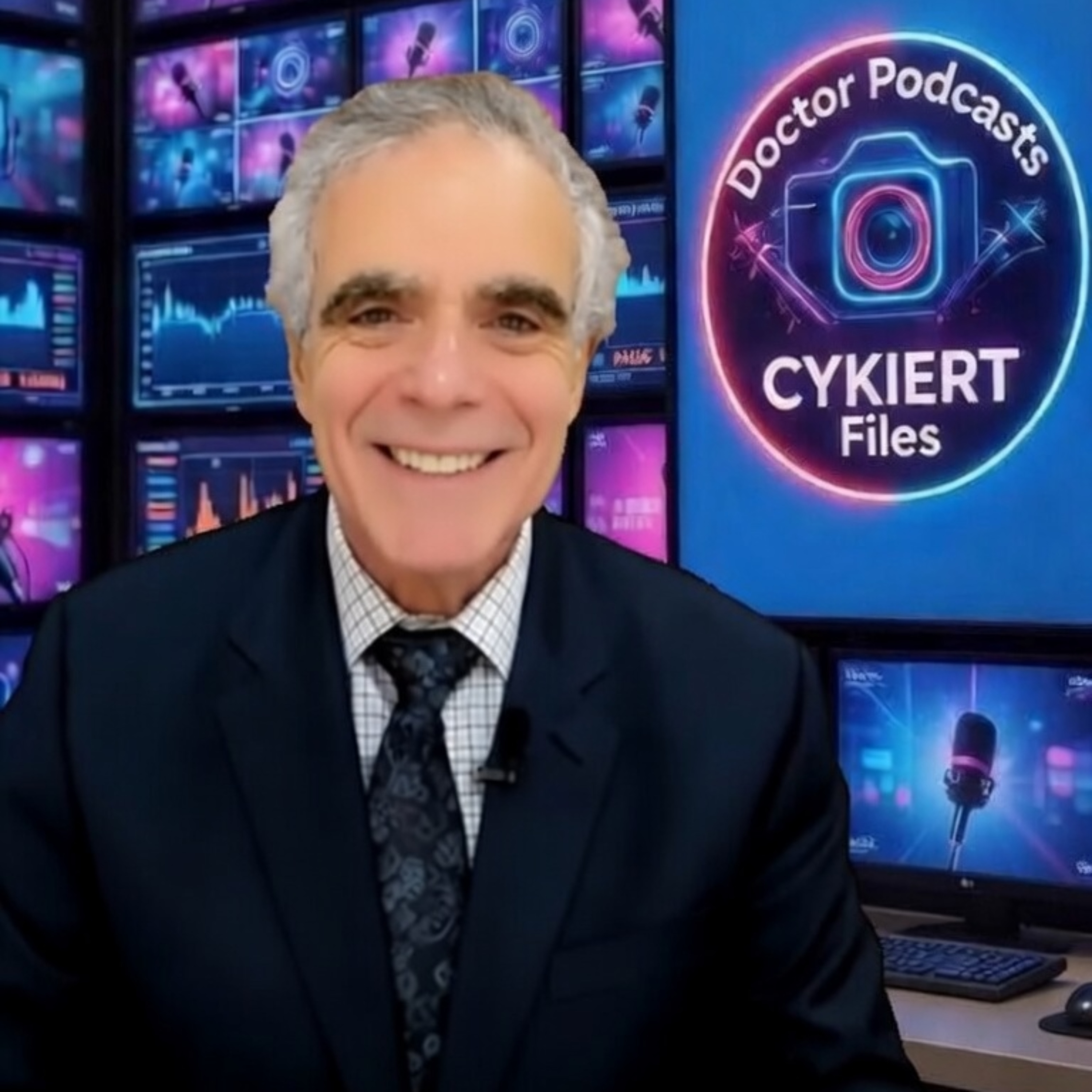
Geneticist & Pediatrician, Wendy Chung, M.D., Ph.D.
In this episode
Wendy Chung, M.D. Ph.D. - Professor of Pediatrics @ Harvard Medical School, Chief of Pediatrics @ Boston Children's Hospital. Discovered ~ 50 genetic diseases, some named after her. A top USA doctor! https://childrenshospital.org/newsroom/news-and-events/2023/boston-childrens-wendy-chung-pediatrics-chief… & http://WChungLab.com
Hi, it's Doctor Robert Seikert. Welcome to a new episode of Doctor Podcasts. Up to now we've interviewed doctors in the New York City metropolitan area, but we're getting increasing interest from doctors around the USA who want to do a Doctor Podcasts episode. So today we're going to do a Televideo interview of Doctor Wendy Chung. Dr. Chung is an MD and APHD in Pediatrics and APHD in Genetics from Rockefeller University in New York City. Dr. Chung is a professor of Pediatrics at the Harvard Medical School, which is the top medical school in the USA, if not the world, and she's also the Chief of Pediatrics at Boston Children's Hospital, which is ranked one of the top two children's hospitals in the United States.
Doctor Chung and I will be discussing various topics relating to diseases that she's discovered that are genetically caused and that many of them are named after her. Stay tuned for this exciting Televideo interview of Doctor Chung. You have an amazing background in in genetics and you've discovered many genetic diseases in the pediatric age group. Can you tell us how you got interested in genetics? I understand you got your PhD in genetics at Rockefeller University in New York City.
Yes. So I've always been a very logical and anti politically minded person and began taking genetics as an undergraduate. It was just very logical and made a lot of sense and used genetics in combination with my background in biochemistry to understand inborn errors of metabolism. And the year that I started medical school and my MD PhD program was the year that the Human Genome Project was announced. And with that understanding began to realize the opportunities that would be available was the genome were entirely sequenced.
And as we have that road map and Encyclopedia of Human Biology, so began to think about a future state in which we'd have that information at our fingertips and think about the new frontiers of what we might do to both diagnose and treat human conditions. And so that became a long but interesting journey in terms of both understanding the genetic basis for disease, understanding the mechanisms by which those genes cause disease and ultimately, as we're now doing, developing treatments for those conditions.
That's that's quite a lot of work. I want to drill down into some specific disease states that you've done genetic research and specifically recently in diabetes and obesity. Can you tell us about your work with those two?
So that was actually where I began much of my work. So as a graduate student, we were working on the genetic basis for obesity. And at the time this was extremely difficult to clone genes for diseases. But with a group at Rockefeller University, we cloned the genes for what were then called the OB or obese mouse and the DB or diabetes mouse and clone those as leptin and the lectin receptor. And with that gained great insight into the regulation of body weight and how we defend that body weight, how we regulate our body weight.
So that became really a journey in terms of understand how to positionally clone and identify new genes for disease. And although humans do have mutations in those same mouse genes, they're not a common cause of obesity. But yet, understanding those genes and how they regulate body weight have helped us understand for the average person what those processes are to be able to regulate body weight. And so even though those are not common in terms of genetic causes for human disease, those insights have been incredibly helpful in terms of understanding common disease.
And that's one of the things is that rare informs common conditions and so even genetics of rare diseases can be quite powerful. What about autism? I understand you're you've done some research on the genetics of autism with the Simons Foundation. Can you tell us about that? Sure. I was previously the Director of Clinical Research for the Simons Foundation for over a decade and with that guided a lot of the development of cohorts or large groups of individuals with autism and related neurological disorders Through that.
One of the two code words that we developed, large code words, one is called SPARK or Simons Foundation powering Autism Research for Knowledge. The second one, what I consider a sister study, Simon Searchlight, is a large group of approximately 200 different genetic conditions. In each of those conditions associated often times in about 25% of those individuals with autism. And so those two large cohorts spark for instance, numbering over 100,000 individuals with autism and their family members.
Those two large studies are have data that are freely available in a de identified way to the scientific community to be able to advance our understanding of contributors to autism, understanding how it changes over the life course and ultimately we hope, how to support individuals better, both individuals with autism and then with those genetic conditions and Simon Searchlight. There seems to be an increased incidence of autism. Or maybe it's just in the news some more and there's, you know, some connection that people talk about with vaccinations, with your background and experience and knowledge, do you think there's any connection there or association?
I do not think there's an association with vaccinations there. The CDC has been tracking the prevalence of autism over time and in those reports from the CDC that prevalence has increased overtime. That's probably due to a number of factors. Included within those factors are increasing recognition of the condition to a certain extent, changes in the definition of what autism is. And there can be other things that are changing in society around us. And so there may be contributors to that, some of which are more ascertainment so to speak or reporting and some of which I think a small portion of which could be actual change in numbers if there are changes pages.
But I'll be pretty clear that people have looked very carefully at the associations between vaccines and autism and there is no robust reliable data to make that connection. And in fact the original paper that made that connection was in fact a fraudulent paper that was retracted and that the author of that paper lost his medical license for that fraudulent paper. So unfortunately that gain traction in the public, but it's really not a reliable research finding. Well, that's that's great to know from a A source and authority.
Thank you for that. You've also done research on the genetics of of heart disease, I know and as you know there are recent reports of cardiomyopathy or heart inflammation associated with COVID vaccines especially in young individuals and males. Do you think there's any connection there? Within this, I'll I'll try and clarify that I study largely genetic cardiomyopathies rather than myocarditis, which is I think what you're referring to. Well, might there be a genetic predisposition that some individuals have who have certain genes?
And then get the vaccination and somehow that triggers the cardiomyopathy. Right now, we don't have any evidence to support that. It's not a common finding with with that. So while I can't rule that out, it certainly isn't something that we're commonly saying. But again, the cardiomyopathies that I study tend to be more hereditary cardiomyopathies. Sometimes the things that you'll see associated with an athlete, a football player, basketball player who unfortunately will pass out on the playing field or in some cases even have a sudden cardiac arrest.
Cardiomyopathies are actually quite common, in total about one in 500 individuals, and represent one of the more common genetic, monogenic or single genetic forms of heart disease. Are there any specific tests that can be done now on individuals so that we can determine who's at risk for that? Sure. There are genetic tests for where almost everything that's genetic cardiomyopathy is included. And we've had genetic tests for that for, you know, over a decade that's been reliable and very accessible and covers a panel of genes associated with cardiomyopathy.
So individuals who may have a family history or if their doctor may suggest that that's a diagnosis for something as simple as a cheek swab, that genetic diagnosis can be made and is helpful for that individual with the cardiomyopathy and can also be informative for their family members. Because this condition we say is autosomal dominantly inherited, meaning that if you have a genetic form of this condition, there's a 5050 chance that your siblings or your children. And as an example, we'll have the same condition.
And knowing about that can be helpful in terms of managing your heart health. Well, since it's pretty accessible tests, should all high school athletes who are planning to become college athletes and maybe enter the pros be tested for that? Because we've seen many recent episodes of athletes having difficulties with that. It's an interesting question. The test itself is not perfect. So what I mean by that is that the results of that test would not necessarily exclude all cardiomyopathy. So, you know, in terms of sensitivity for screening, I don't know that it's a perfectly sensitive test.
I do think it's important for people who have a family history, for people who have symptoms, be they symptoms of passing out or Lightheadedness or perhaps problems with chest pain or palpitations, racing of the heart, things like that. Certainly should have that checked out by their doctor and if necessary a cardiologist and have appropriate work UPS for individuals with that family history or personal risks factors. Those are the people that I think are most useful right now in terms of that genetic testing.
But you do allude to an interesting future possibility which is that when we understand this better, it is possible that more individuals will be screened and in part that may be driven because there may be even genetically based therapies that would be most effective for individuals diagnosed at early disease states, even potentially pre symptomatically. So I think stay tuned, it's an area of investigation and an interesting question you raised. Right. Does CRISPR, the editing technology for DNA and genes, possibly have a role in treating patients who have these genetic disorders?
So a couple different methods that you refer to, whether it's CRISPR, Cass or Prime editing or ways of being able to manipulate genes are in their very earliest stages. Right now we're testing to see whether or not they're both safe and effective and we need both of those things to be true before really diving into this. But they are potentially exciting treatment options in the sense that white one might be able to make corrections to either particular organs where these organs have dysfunction or potentially even multiple parts of the body and could be you know a a sort of cure in the sense of being able to do one treatment and and be able to fix the problem.
Still very early days. So I think it's premature to speculate exactly how widespread we'll be able to do this and how effective it's going to be. And I do raise the safety issue because we do want to make sure that the editing or the corrections that are done are specific to where the corrections need to be and that they're not off target effects or places that alter the genetic information other than the region that was targeted. And certainly some of these methods are improving in terms of being able to hone in on just the exact spot that this is something we're still watching and and it takes some time to watch people and give them enough time to see whether or not any of those off target effects occur.
Right. So it's not like editing with Microsoft Word quite yet, but it it may be headed in in that direction in the future. Now you've there was an article about you in Wall Street Journal few years ago where they mentioned you've discovered 28 different genetic diseases in the pediatric age group. Have you discovered any new ones recently and what what is the future of that Discovering more conditions?
Will we get better and better and faster and faster at this over time? So I've lost count to be honest. But we're over 50 genes that we've described from various different conditions, some of which bear my name. And as we do this as an example, it's been remarkable that as I described the first genes that we cloned OB or DB took over a decade each to be able to identify the last gene that we identified. It was a matter of rather than 10 years, 10 days. So it really are this. The speed with which we can do this has dramatically improved with the sequencing of the genome.
So the technology is improving exponentially, which is, which is great for patients who have these problems. Now in addition to all your medical discoveries and research, I understand that you were involved in a very important gene patent suit that went all the way up to the Supreme Court. Can you tell us a little bit about that and the significance of that?
Sure. We just recently celebrated the 10th anniversary of that Supreme Court decision to the work leading up to that started well before that. And it was driven by problems that my patients were having with access to genetic testing. And those access problems were due to individual individuals who held patents on genes. So individuals who had cloned genes the same way I had, but when they cloned genes, they took out patents on those genes that gave them sole access to be able to diagnose those conditions.
And with that sole accent, it meant that there was a monopoly, literally only one laboratory, that was able to do genetic testing for certain genetic conditions. And laboratories or individuals who held those patents would issue cease and desist orders where other laboratories could not compete, could not offer similar tests. And it was a result of that. The cost to the cost of testing was high, the quality was sometimes compromised and innovation was stifled. And furthermore, when we were thinking about developing genomic tests that would look not just at one or two or three genes, but actually looking at all 20,000 genes, it became not possible to do that.
If, say, 10% or 20% of the genome were covered by patents, you literally would be blinded. You'd have to ignore a significant portion of the genetic information, and that just didn't seem to make sense in the sense that genes are a product of nature. There's something that weren't invented. You know, when you think of patents, you think of inventions, and these were not invented by any of the scientists who had discovered these genes. They simply discovered what were already products of nature. And so we made the arguments in that Supreme Court case that in the same way that you shouldn't be able to patent gold, you shouldn't be able to patent human genes.
And so that case ultimately did go to The Supremes and was a unanimous decision in favor of taking down gene patents to read out information content. And almost immediately there was an explosion, in fact tremendous improvement in expansion of access of access to genetic testing for patients, which has continued to this day to be incredibly important to advances in genetic medicine. That's great. Thanks for your role in that. As you know, AI or artificial intelligence is in the news every day now.
How's that affecting the work you do, and where do you think that's headed in the next few years, especially with genetics research? So machine learning and methods to be able to computationally analyze large amounts of data are being used throughout society, and medicine and genomics is no different. This is especially true when you have large amounts of data. And when we think about our genome, our genome is exactly that. It's 3 billion alphabet letters for every one of us, and it's a huge amount of information to ingest.
Given that although we're 99.9% identical as humans at one in 1000 base pairs where we differ are important and determine important differences between us in terms of health and disease, to be able to recognize those patterns is difficult for any one of us to do. We get flurry eyed looking at all that information and trying to parse it and to make sense of it. And so it's only by looking at information not just from a few people, but literally hundreds of thousands of individuals from around the world.
Given the diversity that we have in genetic information around the world, it takes large amounts of information like that. And being able to pair that with clinical information about those people, how they're doing with their health and how that changes over time to make those associations between genetic variants and in some cases, differences, human differences and how our bodies work. And so doing that, we've increasingly automated that process to recognize those associations, to recognize those genetic variants that are associated with important human diseases and to interpret that information in a more automated way.
And that's allowing us to be able to do genetic diagnostics much more efficiently, much less expensively, much faster. And on much larger scale. And hopefully we'll be able to do that in studies such as the Guardian study that I'm doing of newborn screening and being able to be more equitable in access for this information to more individuals so that they can lead healthier lives. That's great. I know you also do some cancer genetics research that probably will also incorporate AI and and help you with with that as well I would think.
So the artificial intelligence or restraint learning that we just referenced really is applicable to all genetic information and interpretation of the information. So as we've been talking about whether it's cardiovascular disease, whether it's obesity, whether it's cancer, really it's able to benefit everyone in terms of different types of genes and genetic testing. So, very broad, very applicable to almost all areas of medicine and genetics. That's great. One last final question. Thanks for your time to this evening.
We really appreciate it. When do you think you're getting your Nobel Prize in medicine with all the great work that you've been doing that's helped all of humanity?
Well, I don't know about a Nobel Prize, but that's not why I do what I do. So I'm not really worried about that. With the patience that I have the honor of being able to work with. It's just a real pleasure being able to touch lives one by one, day by day. So that's where I get my satisfaction and my joy. Well, keep up the great work. We all really appreciate it very much. And thank you for your time today, Doctor Chung. Thank you as well. All right. Take care. Bye, bye. Stay well. OK. Bye. Bye.
 Apple Podcasts
 Spotify
 YouTube