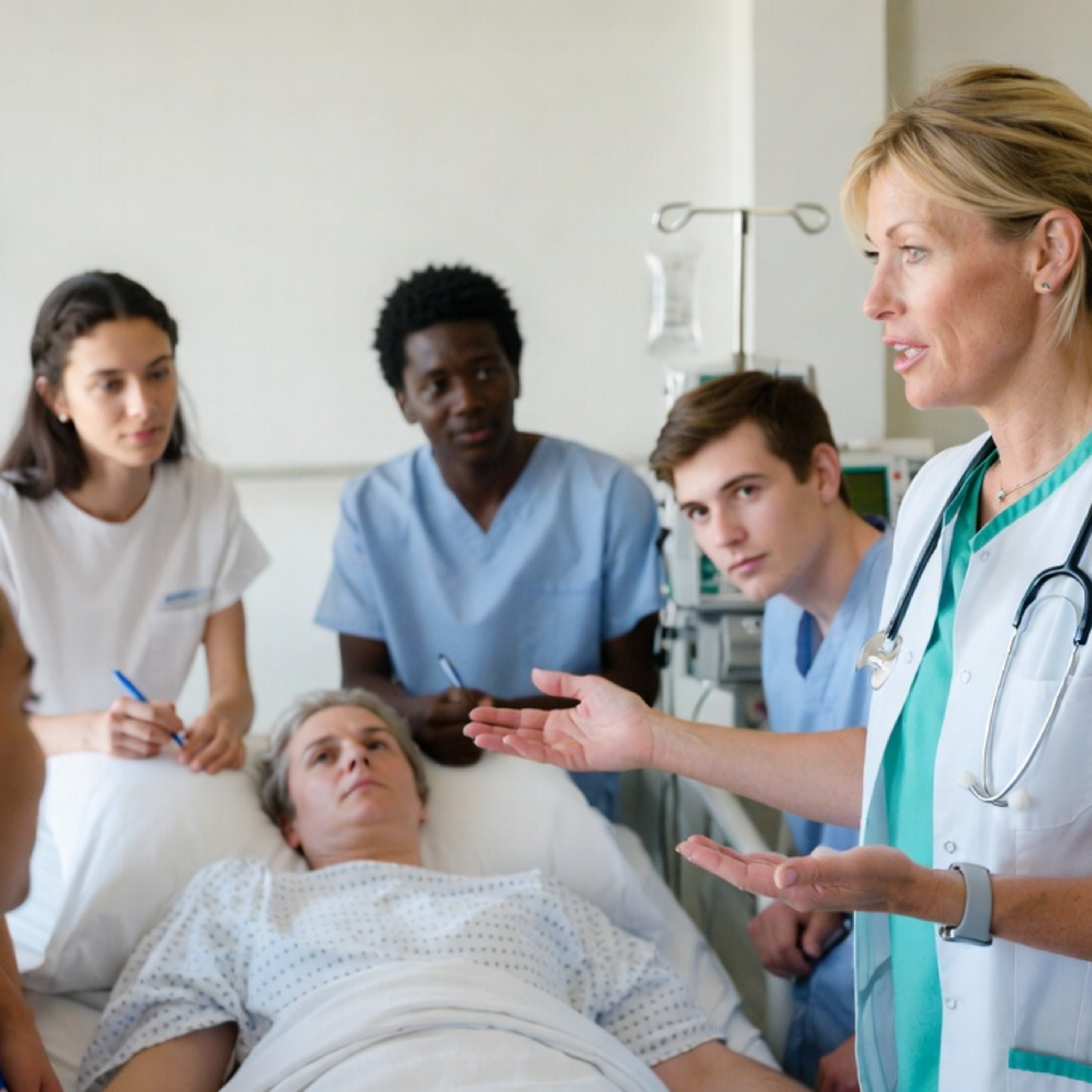
Revolutionizing Medical Education to Prepare Future-Ready Physicians in the AI Age
In this episode
DoctorPodcasts video podcast EPISODE 148:Watch David L. Battinelli M.D, , Dean of the Zucker School of Medicine and Physician-in-Chief of Northwell Health in Long Island, NY, co-author of a new book, Revolutionizing Medical Education: A Proven Blueprint to Transform Curricula and Prepare Future-Ready Physicians, discuss how to change traditional medical school curricula to prepare physicians for modern medicine in the AI age. Book information at: https://www.wiley.com/en-us/Revolutionizing+Medical+Education%3A+A+Proven+Blueprint+to+Transform+Curricula+and+Prepare+Future-Ready+Physicians-p-9781394416042 Dr. Battinelli information at: https://faculty.medicine.hofstra.edu/1484-david-battinelli#DoctroPodcasts is the leading physician-hosted video podcast that informs, inspires and builds trust in healthcare and medicine. Watch all 148 episodes of the DoctorPodcasts || Cykiert Files video podcast interview show with physicians, scientists, healthcare specialists, entrepreneurs and other experts. Please SUBSCRIBE & FOLLOW @DoctorPodcasts. Please LIKE, REPOST/QUOTE and SHARE the episodes https://www.doctorpodcasts.com/index-of-doctorpodcasts-episodes/.Send questions, comments, suggestions, reviews and messages to @DoctorPodcasts. Thank you. Robert Cykiert, M.D.#AIinMedicine
#MedicalEducation
#FutureOfMedicine
#MedEd
#HealthcareAI
#DoctorPodcast
#MedicalSchool
#RevolutionizingMedEd
#HealthTech
#AIMedicalEducation
#PhysicianLeadership
#DigitalHealth
#MedStudentLife
#PodcastForDoctors
#AIinHealthcare
#DoctorPodcasts
#FutureDoctors
#MedicalInnovation
#CykiertFiles
#healthcareleadership #hofstra #northwell
#battinelli
0:00 Hi, thanks for watching episode #148 of the Doctor podcast program. I'm your host, Doctor Robert Sicard. Please subscribe to follow, like, and repost Dr. podcasts in our episode so that we can get more great guests like today. Today I have the distinct honor to have a conversation with Doctor David Battinelli. He is the Deborah and Lauren Smith Dean of the Donald and Barbara Zucker School of Medicine at Hofstra Northwell in Long Island, New York. He also serves as the executive vice president and physician in chief of Northwell Health in New York.
0:36 Doctor Battinelli is board certified in internal medicine. He's a founding member of the Zucker School of Medicine and previously served as vice Dean, Dean for medical education and chaired the committee that designed the school's innovative curriculum. Before joining Northwell in 2007, he was vice chair for education and the internal medicine residency program director at Boston Medical Center and Boston University School of Medicine. Doctor Battinelli is the co-author with Founding Dean Emeritus Lawrence G Smith of the new book called Revolutionizing Medical Education, a proven blueprint to transform curricula and prepare future ready physicians.
1:20 And I have a copy of that book right here, which we'll talk about at great length. Doctor Battinelli, thanks for taking the time to join us today and telling us about your groundbreaking new book. We really appreciate it. My pleasure. So I'd like to ask you, you've had a distinguished career as a clinician and educator and now is Dean of the Zucker School of Medicine and Physician in Chief at Northwell Health. What personally drove you to help found a brand new medical school from the ground up.
1:51 Yeah, no, I think I was in the pretty comfortable at Boston University. I've been there for 25 years. But all of us who have been in education have been quietly, you know, thinking on the side, dreaming about what would have been an opportunity, for example, to start, start fresh, start from scratch, especially if you had the right resources, you had the right governance, right partners, and taking a shot at attempting to build a new school and and change medical education. Many of us have been at many schools for many years and for a variety of reasons, some budgetary, others, you know, tradition, whatever it happened to be, it's really tough to to make the kind of changes that that we dreamed about.
2:35 So when I was offered this opportunity to leave Boston, come back to New Yorkers, which is where I'm from, that wasn't as big a stretch as, you know, maybe moving to California. Wow, that's great. Now tell us when the Zucker School of Medicine got started and and what was your role in that? Yeah. So we partnered with Hofstra University in Northwell Health and Hofstra to do really this joint effort. We signed the proclamation to do this in March of 2008 and we spent a good part of two years, almost three.
3:11 Our new class started in 2011, gathering information, scouring through the country, talking with some of the best educators, friends and trying to put together what would be the curriculum of the future. And by that we meant no one who started that school be before 20/10/2011, for example, would actually be an independent practice until the year 2020. So we were really aiming at 2020. Wow, so a lot of work for many years to to get it done, but you did it. That's incredible. Now tell us about the huge Northwell health system in New York.
3:49 Yeah. So one of the opportunities was when I first came down, I'm the Chief Academic Officer for Northwell Health. And Northwell Health at that time I think was only about 11 hospitals, but had a large graduate medical education experience, was teaching medical students from several other primary medical schools such as NYU, Albert Einstein and others and had a Research Institute. So clinically, they were doing well and they were clearly going to expand. And as you know, between that date and now, they've grown to 28 hospitals and operating revenue of $25 billion in over 1200 ambulatory locations.
4:29 So all of the clinical resources anybody could ever want, we're here at Northwell Health. That's amazing. I, I understand. I, I believe it's true that Northwell Health is the largest employer in New York State. Is that correct? The largest private employer in New York State? Yes, with the slightly over 106,000 employees, yeah. Wow, that's incredible. Really grown a lot over the years thanks to your hard work. Now, before Zucker and Northwell, you were deeply involved in graduate medical education at Boston University, as I earlier mentioned.
5:03 How did that experience shape your vision for what a 21st century medical school should look like? Well, you know, one of the things that we go over in in our book, for example, is we sort of trace our time from being in medical school. Doctor Smith was started medical school in the early 70s. I started in the late 70s. And we were really, you know, front and center during the majority of the transition in how healthcare and graduate education and medical school education was being delivered. And because we ran graduate medical education training programs, we were always very interested in the product, what medical students look like as their way into graduate education.
5:42 So we were all front and center in all the conversations at the A/C, GME, the A/B IM, the ACP, double AMC about what were the challenges. So we, we, I, I wouldn't say that we had all the solutions at the time, but we certainly understood the issues. Right. And from that you developed this new program here and at Sucker and Northwell. Now your book is titled Revolutionizing Medical Education. As I mentioned. What is the core problem you believe with traditional medical education that you and Doctor Smith set out to solve?
6:19 Yeah. So if you look at, you know, medical education, what are you trying to do? You you are trying to take a very bright group of people. And there's no, there was no shortage of that. There's always been a lot of people interested in going to Med school, but figuring out how you would get them to learn the science necessary and how to apply that science in the clinical context and, and do so in an empathic and compassionate way. And I think the formula is much more complicated than that. The problem, of course, was that it was all segregated.
6:47 We would have people teaching science for a couple of years, then we would expect them to be able to figure out how to apply that in a clinical scenario. And then, you know, because you aren't actually delivering care, then expecting people to learn how to be empathic and compassionate, delivering care without delivering care. So there were a lot of contradictions in the system. It was all lecture based. The assessments were multiple choice. The clinical work didn't begin until this third year. So for everyone looking at this, we all would have likely arrived at the same conclusion that we needed to pull this all together.
7:23 We needed to integrate the clinical care and the science. We needed to use modern technology for getting information, and we needed to learn how to be empathic and compassionate by actually delivering care. The problem was, how would you change an institution to be able to do that? I don't know anybody that's been able to do that. However, if you could start from scratch, you know, build your own house, you'd probably do it differently. Right, good point. Now one of the big shifts that Zucker was moving away from heavy reliance on rote memorization and traditional exams.
7:54 I remember when I went to medical school, it was just tons of memorization, memorizing every nerve and muscle and organ in the body and cells and so on. But how else can medical students learn important facts about, for example, anatomy, Physiology, pathology, pharmacology, without spending huge amounts of time memorizing this material so that they can later apply it to clinical situations in patients? Yeah, I guess try to tie together a few points. 1 is that the traditional medical school has several, if not the dozen different departments, the anatomy, the biochemistry, the Physiology, the Histology, the Embryology, etcetera, etcetera, all buying for the same science.
8:40 We decided that that was not what we wanted to take on and and we created a single department of science education where the anatomist, biochemist, physiologist, histologist, embryologist, they all had to figure out what was, what were the learning objectives that were common to each of them. That was one job. The second job was we needed to embrace new ways of that, the way information was obtained. When you and I were in medical school, the only thing that we could do is either read books frequently we're outdated, but we listened to lectures, We had people transcribe every word and we were assessed with multiple choice questions based on that information and given a grade.
9:16 And somehow that grade, even when we were just doing science, was supposedly representative of what kind of doctor we would be. So lots of things that didn't really make sense. So what we did was we said, listen, information now is gathered differently. You and I would go to the library. Nobody's going to the library now unless they want some quiet time. They're they're looking on their computer or on their iPhone and they can gather information instantly. We were tortured. We had no way to get information.
9:43 And you know, they have this luxury of grabbing information, just like you and I would learn how to bake a cake or change a pipe at Home Depot. We'd go on YouTube, we'd look on there and somebody would show us and we we'd figure it out. We're relatively smart enough to sort of do that. So what we did was we abandoned lectures. We gave what we call framing sessions once or twice a week. We would go over something that would give you your expected level of competence and how much you actually needed to know.
10:08 But we would learn the science in small groups, what we call pearls, which were patient explorations and active reasoning, learning and synthesis about cases in groups of eight students. And they would teach each other the learning objectives about leukoniogenesis, diabetes, liver disease. And we would do it in an integrated fashion. Sounds chaotic and people said, you know, how's that going to work? But it works remarkably well. And then our assessments, no multiple choice question tests. They were orals, essays, simulations, standardized patients and practicals.
10:44 And what we believed was if you could explain it, what we called knowledge and action, then you knew it. We were criticized that people said we weren't going to pass, you know, standardized board exams. We knew the students were some of the best test takers in the world. That's how they got into medical school. We didn't think they were going to forget how to do that. And, you know, if you can actually explain those things, you can. You do well in your standardized tests. And we were a full standard deviation above the mean nationally.
11:10 Students took those exams. You're right. The other thing that we did, probably most important is that we, we, we became what we call pass fail or no grades. And that meant that we needed to tell the students. The last thing we need you to do is to to perpetuate the crazy pre Med competition of competing against your peers and instead you collaborate with your peers. You compete, but you compete against the standard of excellence that your patients deserve. Not you deciding you're a better doctor because you got a slightly higher score than the kids sitting next to you, which you and I went through that.
11:52 We can't defend it, but it's not something we wanted to propagate. Right, great idea because I remember I took all these separate courses and then I had to synthesize it and put it all together. And then when I started taking care of patients in the third year of medical school, I had to apply all that information. But you're doing that right from the beginning, and learning all the basic science at the same time seems like a a great idea. Yeah, we, you know, we did another thing and that was that we put and we were challenged on this.
12:22 We put literally 3 to 400 hours of clinical care into the first two years. And that was probably the most important thing we did, one of the most important things. Now, the challenge, of course, people said was, well, if you know, if you put that much clinical care into the first two years, they won't learn the science. And we were accused of maybe trying to dummy things down. But what we put in the first two years was a very unique curriculum of the same, the same clerkships that you and I did in our third and fourth year, medicine, surgery, psychiatry, OB, Pediatrics.
12:56 We put every student into each of those practices for two years in their first year, not every day, once a week, 1 1/2 times, so that when they got to the upper years, they were intensely prepared. They had already delivered babies, taking care of adults, first, assisted on operations. And it was a little bit of good clinical preparation plus establishing the relevance of why they were learning the science that kept them engaged to keep them learning the science. Now that required an enormous amount of resource.
13:29 And because Northwell Health was large, as you mentioned, I had upwards by the time we were at 100 students per class, 500 practices that took our students in on a, on a very unique relationship. So rather than that student, you know, wheel new student every couple of weeks and you never really got to know them. They never really got to know you. These are one-on-one relationships. So if you were the surgeon, you would have that student for two years. And so each time you met them, you didn't have to teach them what the sterile field was again and again.
14:02 And you watched them progress as you would in any sporting activity, dance activity, music activity, or anything else you were trying to do. Right. I, I think there's a huge synergy between your medical school and the fact that Northwell had all these clinical facilities which allowed you to merge the two together. You couldn't have done it without the the two being combined that way. It seems it. You're right, it would have been impossible. And in fact, you know, having been at other institutions, this single biggest challenge at almost every single institution is providing the clinical opportunities for their medical students.
14:39 Right, Yeah. So it worked out. That's great. Now, how do you actually make that happen? A curriculum so students connect with patients early and and meaningfully 'cause they're they're kind of young, they're just out of college. Are they ready to meaningfully interact with patients at that point? Again, one of the challenges that we took on, so the way that we began the school is on the very first day of medical school and for the next 8 weeks, they train as emergency medicine technicians. But we call, we call it EMT on steroids because it's not just, you know, what would be a typical course to, to be an EMT, you need to have a high school education.
15:23 This was EMT for doctors. And so we would teach the autonomic nervous system, we would teach resuscitation, we would teach how the brain functions. We would. And then we would also indoctrinate them in a little bit as to how we were going to expect things. But what was the imprint was that you will be clinically trained. You're riding on ambulances, you're doing a 911 calls, you're in an EMT uniform, you'll be delivering babies in in the ambulance, you'll be seeing gunshot wounds. You So this idea that you're, you know, like when you and I were in Med school in the beginning, we're like, is this Med school looks like college to me.
15:53 But this, this was Med school and we made that clinical, we made that clinical imprint. So that that was that was an absolute important message that we needed to deliver. Right. Yeah. My first two years were basically classroom education, which was fine, and then we gradually got introduced to taking care of patients. Now, I've read that the human brain matures fully at about age 25 or so, which is about when people start doing their internships and and residencies. Is it possible that if you're too young, you you can't deal with taking care of patients if you're in your early 20s and maybe you need to wait a few years or you found that that's not the case?
16:39 Yeah, like we, we you know, to the latter, we found that that's not the case and that we actually put our our students in real life clinical scenarios. And and the reason we believe it worked is because it was real. So if you, some, some places like to introduce people into observerships and they call them shadowing experiences, which is following somebody around, you know, these are highly accomplished students. And whether the, the, the average person matures at that rate or not. I'm not saying doctors are special, but these are very intelligent kids and 2324 and frequently some have taken a year off.
17:16 They're ready for that and they, they like an authentic, deep, meaningful experience. And, and what we found out even through the years as we've gone, is, is the deeper and more qualitative that experience is way better than a bunch of, you know, much more shallow, superficial experiences. And we all know that as we care for patients, the deeper and you get into it, the more engaged you are as a person. So yes, that, that was a concern. Everybody's like, oh, well, you can't let somebody in. And I don't want to be glib about it, but I said, you know, I don't know most of the lawsuits and, and the things I know about, I don't see any medical students doing the wrong thing.
17:55 It's usually some attending physician someplace and. Point. It, it worked, I, I, I don't doubt that other people would think similarly. Like Are you sure these you and you want to let this person in there? Right. And, and all these medical students are passing all the same exams that other traditional type of medical schools are are taking. Well beyond all the other medical schools, we have higher pass rates on all our exams, on all the standardized exams, on the double AMC questionnaires in terms of student satisfaction and on the training program directors experiences with our graduates.
18:39 Our graduates are better prepared to deal with uncertainty. They're less anxious, they're more comfortable, they're better colleagues, and it's the way they're educated. It's not that we have special people. Everybody can do this. You know, when you're just sitting in a classroom, you know, bored and, and being, you know, talked at that, that isn't how you develop somebody. Right, so it sounds like the earlier clinical involvement motivates you to to learn more and enjoy it more as well. That's that is our belief that that that is the hypothesis.
19:15 I can, I can tell you that one of the most striking things about students in our school comes about when they're actually the children of physicians. And those physicians come to us and they say, you know, I kept trying to tell my kid about don't worry about the first two years. And, and they have no idea what I'm talking about. They they seem to like pedicle school. So you're doing something right, is what the message usually is. That's awesome. Now the Zucker model has attracted visitors from over 50 medical schools worldwide.
19:48 What are the most common AHA moments visiting Deans and faculty have when they see your program in action?
19:58 A number of things. One, the collegiality between our students and the way our students teach each other and support each other to learn together is distinct.
20:09 Watching them in small groups do the teaching, watching how they're able to analyze a complex case, decide what needs to be learned, and then go find the information. And so we will have them look at a scenario on a Monday and then tell the visitor that by Wednesday they'll be teaching those concepts to their peers. And they look at us and we look, and we did the same thing initially. Like, I don't think that's possible. And then you see it and you're like, I still don't understand how it happened, but it happened so I need to learn more about this.
20:43 Interesting. Now what are the biggest practical changes medical schools can make right now, even if they can't rebuild their entire curriculum all at once? You you kind of were in a unique situation because you started from scratch, so you were able to develop this. But what about all the traditional medical schools? How do they switch to this type of program? Yeah. No, that's very fair question. I think there's a few things that the people come away from and they say, look, it's it is pretty clear that we can trust the students more than we used to.
21:21 It's pretty clear that we can do what we talked about earlier. You can get them in front of patients in very challenging situations and they're going to be able to handle it and it actually will be good for them, not bad for them. Like a lot of people are like, oh, I don't think you want to get that person involved in that. You know that that will be traumatic. It's not traumatic. It's developmental and it's and it's additive. They can change their assessment methodologies, get away from the multiple choice question.
21:48 You know, it's a very efficient way of doing it. But you know, the one truism about a multiple choice question test is that the answer is in front of you. All you have to do is figure out which of those it is versus being able to actually explain things. And I think that's what's good about our curriculum with respect to their interactions with patients is that they're used to speaking and trying to figure out how they're going to connect with their faculty, connect with their peers, connect with their patients and get the messages across.
22:17 I also think that being interdisciplinary and making sure, you know, your biochemists and physiologists, anatomists, imaging people all work together and, and not fight each other on, you know, who owns what part of the curriculum that that that's something everybody can do. Right. That was always an issue. The first two years of of medical schools, the department sort of competed with each other to a degree. It sounds like now they're all working together in a in a group and helping each other.
22:45 Well, in other places, I can't speak to as much. I think everybody's better than they used to be. But in our place we only have one department, so departments can't buy with each other. Right. That's great. Now you touched on this a little bit before. What's been the feedback you've gotten from intern directors and residency directors and hospitals and and medical centers regarding how this curriculum has affected the performance of the doctors once they move on to internship and residency and fellowship?
23:15 Yeah. You know, something that we were very concerned with early on, especially as recruiting students. I mean, we didn't have a track record. We couldn't tell them, you know, we know that we can get you this kind of job, that kind of job, but we have we place students in every single discipline in the most prestigious places in the country. And that's not really a testament to us as much as a testament to the student, because these students go and they go on electives, they go on try out rotations and they excel.
23:38 So, you know, we have students. I, I can't even think of a place where hasn't taken their student, everybody from the Mass General and the Brigham to Penn, UCSFUCLA, you know, UT, San Francisco, Duke, Yale, Stanford, everybody. And you know, we had a situation a few years ago and there were 5 chief residents at the Children's Hospital of Pennsylvania CHOP at one time, three of them were our graduates. And so they're doing well. People see that they take a chance on them. You know, I'm sure there's some graduation even amongst their own students, as you might expect, but it's the performance of the students.
24:23 And I and I, again, I think it's because, and we just talked about this at commencement the other day. I, I truly believe talking to our alumni because I talked to our alumni all the time. And I said, tell me about, you know, your experience. I mean, did, what feedback do you have for us as a school to make it even better? They've only, they only went to one Med school, so they can't really give you a comparison, but they do feel that they are more comfortable than their peers at, at dealing with uncertainty.
24:49 And you and I know that, you know, there's plenty of uncertainty out there and you don't want to get anxious, you don't want to get overwhelmed. You don't want any of that sort of stuff to lead to burnout. And it took a long time, right? It takes we, we do this for four years. Four years is a long time. You know, that's the Malcolm Gladwell 10,000 hours model that that's a lot of development versus, you know, a two to four week rotation. And they're like, really, am I supposed to get this now? You know, we all remember when we left Med school, when we left residency, it took us a year or two in practice, right, to really get your sea legs.
25:20 Right, That's correct. So you get your sea legs much earlier this way. That's great. Now with AI, rapid advances in medicine, and changing healthcare systems, a lot of things going on simultaneously, what skills do you believe tomorrow's physicians need most that today's schools still aren't teaching that well? Well, we believe that there are five things that aren't going to go away that we need to address. And we're working hard to try to use AI technologies and other things, much as we did with the Internet and searches and other things.
25:56 You know, we didn't touch on handheld ultrasound. You know, every single one of our students learns point of care ultrasound in the very first day. And that will be the new stethoscope. The stethoscope, we'll have it around you and I may know how to use it, but I think for the next generation it'll be an ornament. And so, but, but the five things that I think have to be addressed 1, the continuum of care, the continuum of care for patients is fragmented. We have access problems, we have communication problems between practitioners, between patients, etcetera.
26:24 So we're working hard on the continuum of care. We believe that medical decision making and uncertainty is critical and that the myth that more data will make things easier for us. So we'll just make it more complicated. And so we still need the best doctors who are those who can make the best decisions with less than 100% of the information, Not because 100% wouldn't help us, but 100% is never available. We spent a lot of time on social context and relieving healthcare disparities. It's a very uneven system and our students need to fully understand, you know, how to advocate for their patients.
27:01 We are much more about quality, outcomes and effectiveness. It's it's what we produce and how our patients do and not how we score on exams. And last but not least, but probably as important, is it's about scientific discovery. The best doctors follow the science for their entire career. And you know, unfortunately the public and science is a little confused. I've heard people say, you know, the reason I don't believe in science is because it's always changing. I'm like, that's the way we're going to look at it.
27:28 We got a problem because that is what science is. So our people need to be able to embrace. And so those that's how we're looking at this and we think AI can help us with each one of those things. There are issues about AI and we don't understand, but if it can help us in each of those areas, that's a good thing. Now, currently, if another medical school or health system wants to adopt elements of the Zucker model, which you innovative, where should they start? According to the book, should they give you a call or send you an e-mail or or How do they go about making these changes?
28:00 Yeah, they they, they figure out how to get to us. I mean, that was the purpose of the book. The purpose of the book was not for us to tell everybody that we've we've found the answer. That wasn't that wasn't the point. Point was to tell them that we've been through the time when it changed. We watched how no one did that much about it. We were given an opportunity to try to do something about it. We think we made some successes, but they were really ideas that we gathered from some of the best educators around the country.
28:24 And now we want to move forward. So we engage, you know, people find us, they, they hook up with us through academic organizations, one-on-one emails, etcetera. They do visits, we have talks. You know, the academic community is not that big, right? There's still only about 150 Med schools in the country, and everybody's struggling with figuring out how to do it. How have the, we'll call them, older doctors adapted to this? I can see, you know, younger physicians saying, hey, this is great idea, but what about somebody who's been in practice 20-30, maybe more years than that, looking at this and and wanting to work with very young medical students while they're doing major heart surgery or some complicated medical process.
29:14 Yeah, I'll give you 2 examples of things. One is that we, we bring those doctors into the laboratories with us and, and you know, when we're doing, when we're doing the heart and the chest, we bring in the cardiothoracic surgeons. They only need to come in a couple times per year, but they love it. They're interacting with young students and they're, they're, they're showing them what they do. They don't have to prepare. We, we give them, we only get, we ask them what you know, to do what they do.
29:36 At the same time, we put students in practices with the doctors. We, we have that one-on-one relationship. So if you, if you only have one student that you need to be connected to over a period of time, it's not overwhelming and it's very rewarding to watch that student actually get better versus seeing somebody for two weeks and you could barely pick them out of a crowd. It's not a very rewarding experience. They, they frequently come to graduation, they, they may want to hood the, you know, the student.
30:03 It's, it's a tight relationship and it's rewarding and everybody wants to do it. They just don't want to be overwhelmed. So that's another one of the things that we've been sharing with a lot of people because, you know, a lot of doctors just feel overwhelmed. They don't have time for students and and they, but they have time for this because it's a different model. Right. And it's exciting. The older doctors love it because they're like wow this reminds me of the way it used to be. Right. Sounds great.
30:32 Well, so now that you've tackled medical education successfully, what's your next major project as Dean of a major medical school? Well, you know, my biggest concern is, is what we call curriculum renewal, right? So we're aiming at the year 2020. That's, that's a half a dozen years in the rearview mirror. And now we're trying to aim at 2040. And, you know, predicting the future is not the easiest thing to do, but it's keeping everybody engaged. It's talent acquisition. It's making sure people realize that as much as we want, you know, to be stable and we, we, we, as we say in our, our values, we are intolerant to the status quo, you know, because complacency is the enemy.
31:12 And then we have a big job to build the research programs to improve science and discovery to eliminate healthcare disparities. We have this enormous healthcare system. One of the things the medical school has done very well for us is it really has transformed this healthcare system from a much more clinical enterprise into an academic health system, attracting phenomenal physicians, great chairs, researchers, and it's all additive. People want to be around places that we're really where there's good action, right?
31:41 Even if even if you're not going to do primary research, you want to be around a place that's discovering things. So it all, it's all additive and it's a constant challenge. Right. Makes life more interesting and increases motivation for everybody. So I want to thank you very much for sharing your knowledge and, and your book, which I enjoyed reading very much. And thanks for your great insights and experiences that you've shared with us. It'll certainly affect everyone's future health and Wellness in a very positive way.
32:13 So thank you very much. No, listen, I appreciate that. And, and you know, one of the things I like to tell people is when you're reading this book, you know, it's, there's a story in there. But the real pearls in this are are those student reflections and narratives that they talk about. And that's how you really understand that. Wait a minute. The the the students are getting it. Right, that's the most. Important. My pleasure. Thank you very much. Thanks.
 Apple Podcasts
 Spotify
 YouTube