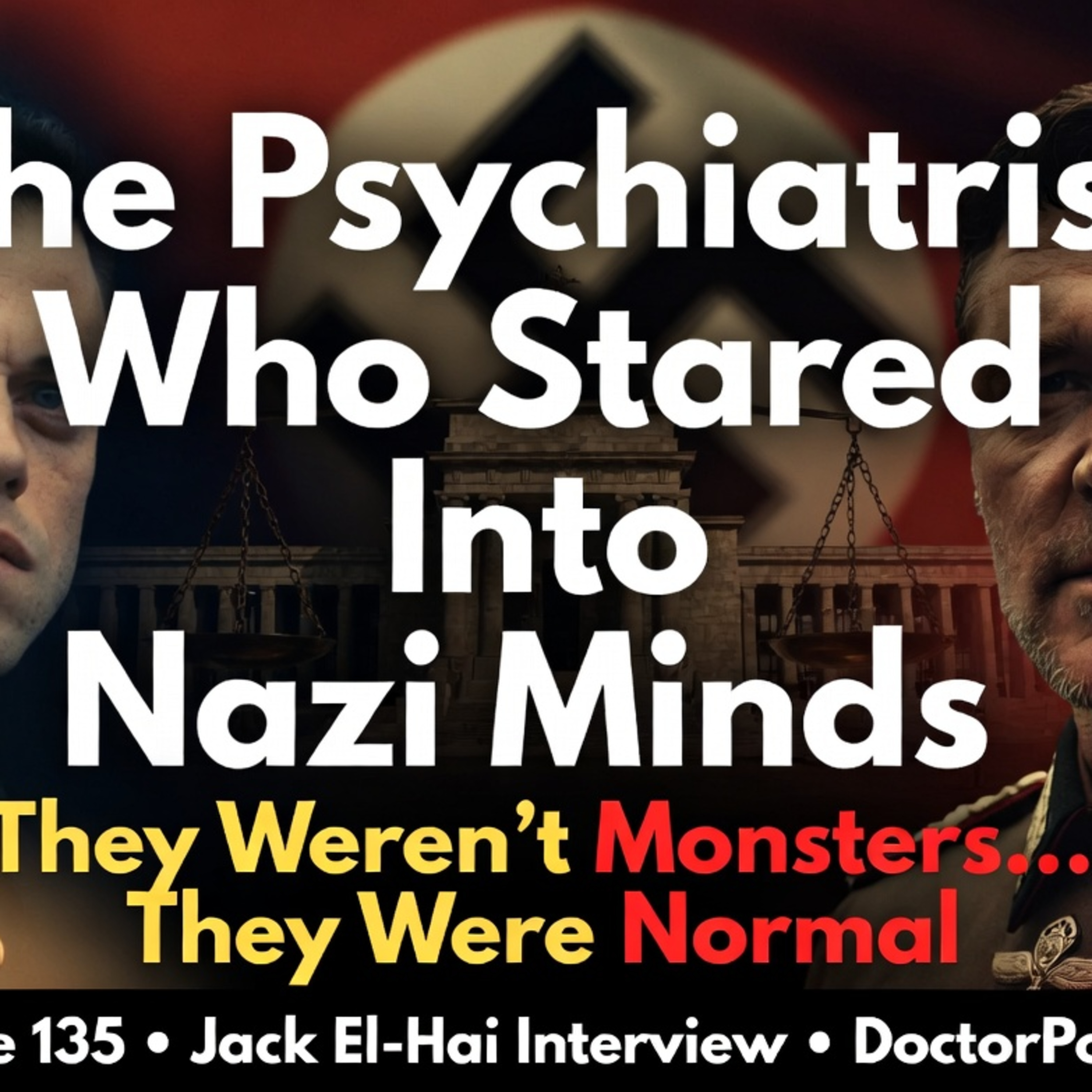
The Psychiatrist Who Stared Into Minds of Nazis… and Found Something More Terrifying Than Monsters
In this episode
DoctorPodcasts Episode 135:What if the men who ran the Holocaust weren’t “crazy”? What if they were disturbingly normal? New episode with Jack El-Hai (author of The Nazi and the Psychiatrist — the book that became the hit 2025 film Nuremberg starring Rami Malek as Dr. Douglas Kelley & Russell Crowe as Hermann Göring). We dive deep into: The shocking Rorschach test results on Nazi leaders.Why Kelley called their personalities “more frightening” than finding monsters.Eerie parallels to authoritarianism and strongmen in 2026How this work destroyed Kelley’s own mental health.A chilling, timely conversation every doctor, psychiatrist, historian, and citizen needs to hear.Watch all 135 episodes of the DoctorPodcasts || Cykiert Files video podcast interview show with physicians, scientists, healthcare specialists, entrepreneurs and other experts. Please SUBSCRIBE & FOLLOW @DoctorPodcasts. Please LIKE, REPOST/QUOTE and SHARE the episodes. Send questions, comments, suggestions, reviews and messages to @DoctorPodcasts. Thank you. Robert Cykiert, M.D.
Hi, thanks for joining episode #135 of the Doctor Podcast Show. And I'm your host, Doctor Robert Sichert. Please subscribe to and follow Doctor Podcast. We're on all these social media platforms including YouTube, Spotify X, Facebook, LinkedIn, Instagram, TikTok. So please check us out on those medias. Please also like and repost this episode that you enjoy so that we can get the best guests on the planet like we have today. Today's guest joining us on Doctor Podcast is Jack L Hi. He's an acclaimed author and journalist who specializes in the hidden histories of medicine, psychiatry, science and crime, all popular topics.
His 2013 bestseller The Nazi and the Psychiatrist, which has now been translated into more than 20 languages, uncovers the extraordinary true story of AUS Army psychiatrist Doctor Douglas M Kelly, who was tasked with evaluating the top Nazi war criminals after World War 2, including Hermann Goering. And this happened before the 1945 and 1946 Nuremberg Trials, which we'll talk about. The book was recently adapted into a major 2025 feature film, Nuremberg, which was directed by James Vanderbilt, and it starred Rami Malek as Doctor Kelly and Russell Crowe as Goering.
Now Jackal High has lectured at Yale, Harvard, Stanford, the Mayo Clinic, the US Holocaust Memorial Museum and many other places. Today, we're diving into the psychiatric insights from that era that feel eerily relevant right now and the events unfolding in the Mideast and Europe and other places around the world. So, Jack, thanks for taking time to join us today to discuss the psychiatric and mental health issues of tyrants and dictators and how it affects the rest of us. Really appreciate it. Thank you.
It's my pleasure to be here with you. Thanks. So I want to start by asking you what got you interested in in the subject of a psychiatrist, Doctor Kelly interviewing a Nazi, and how did you even find out that that occurred? I had never even heard of Douglas Kelly until 2004, while I was researching another book, my earlier book, The Lobotomist, which was about another psychiatrist. And in the course of doing that research, I learned that this other psychiatrist had met Doctor Kelly in 1938 at a conference of the American Psychiatric Association.
And the psychiatrist who was the subject of my research then was really impressed by Doctor Kelly. Not because of anything he said or any paper he presented, nothing like that. It was because Doctor Kelly was at the conference to give a magic show for his psychiatric colleagues, which lodged in my mind too, just as it had in the subject of that earlier book. And after I finished that book, it it remained in in my mind. And I did a little more research on Doctor Kelly and then found that he had, as a military psychiatrist, had gone to work with the German defendants who were tried at Nuremberg in the first trial, first Nuremberg trial, which was called the International Military Tribunal.
And that's what got me going. I think it was just a chance intersection with information that was intriguing. Wow, amazing how things happen like that. Tell us about Nuremberg and the Nuremberg trials and the significance of that. Because it's, it's been over 75 years since that happened and I, I think many people either are not aware of the Nuremberg trials or or maybe have forgotten it by now. So can you tell us about what those trials were? Sure, at the end of World War 2, as the Allies entered Germany, they began arresting the top officials of the Nazi government, and these included civilian leaders and military leaders.
Now, some of the people at the very, very top, such as Adolf Hitler, had committed suicide, but there were still many big fish around. And so these men were arrested and brought to a converted hotel in Luxembourg where they were gathered together. And while that was happening, the Allies were debating what to do with them there. Some of the Allied governments, like the UK and the USSR, really preferred lining them up against the wall and shooting them. But the others, particularly the US as voiced by Justice Robert Jackson, who ended up being the chief chief American prosecutor in the trial, thought that there should be a judicial hearing.
Why? Because it would give the Allies a chance to show the world the mountains of evidence that were being collected, that show the extent of the Nazi crimes before and during the war. So what's significant about this, I think, is that it was an international effort, the four Allied powers and working together, and that this was not going to be a show trial as as the Russians had been conducting for many years already. The defendants would be able to mount a defense and have a chance to be represented by attorneys of their choice, and it would be a fair trial.
That doesn't mean that it was a flawless trial. There were there were many flaws in this procedure because it had never been done before, never had a group of victorious countries tried the war criminals of a losing nation. So that's really the significance of what happened. And I think it turned out pretty much as the Allies hoped. And the extent of the fairness is shown by the fact that of the 22 defendants in this first trial, three were acquitted and the others, many of them sentenced to death, others to long prison sentences.
That's a very interesting background and important to know now. Doctor Kelly went into Nuremberg expecting to find the distinct psychiatric disorder that explained the Nazis crimes. What was his biggest discovery about their personalities, and why did he ultimately call it more frightening than finding monsters? The tribunal asked Doctor Kelly to come to be among the defendants to assess whether these men were mentally fit to stand trial. So did they meet the legal definition of mental fitness? And that's a much lower bar than the medical definition of mental fitness.
And this was a pretty easy task of somebody like Doctor Kelly and his accomplishments. He was quite young. He was only 33 when this happened, but he had already served for several years in field hospitals on the Western Front, working with soldiers who suffered from what today we would call PTSD, and having with his colleagues some success in treating them. He was of relatively high rank, and he was available and nearby, so that's why he got the call to do this. But once there among the defendants, though, Kelly realized how envious his position was.
There were many, many psychiatrists who would have loved to have switched places with him because there he was among the men widely considered to be the worst criminals of the 20th century, and he had an opportunity to study them. So he decided he would really study them, and he devised a project completely under the radar. This was not sanctioned by the Allies or by anybody in the prison, but to determine whether these men suffered from any shared psychiatric disorder that could account for their crimes and horrendous behaviors before and during the war.
So he came into that, as you said, with a hypothesis that they did share what he called a Nazi virus, his metaphorical term. And although he didn't know what it was or could be, but what he learned was that not only did they not share any kind of disorder, but none of them had any kind of disorder, that they all fell within the normal range, what he considered to be the normal range of human, of the range of human personality. And, and this was very upsetting to him for two reasons. One was it meant that his beloved medical specialty, psychiatry couldn't explain them, couldn't end their behaviors.
But even worse, this normal aspect of these men suggested to Doctor Kelly that that if they're normal, then there are others like them, also normal, who are all around us, maybe not terribly great in number, but always there in every country, every culture, every era. And Doctor Kelly believed that the war, the end of the war and Germany's defeat would not end these authoritarian Nazi like right wing movements. And even the Nuremberg trials, the series of trials would not end it. And that we would always have to contend with people who are capable of this, of authoritarianism and the crimes that come out of it.
And that really alarmed him. He had not realized that before his time with the Nazis. So he returned to the US and saw our country in in a very different light. This was 1946. When he returned home, the Southern segregationists were in full force, these demagogue politicians who were legislating Jim Crow laws and bringing about voting restrictions for black voters in the South. And even more important to Kelly, they were using propaganda, emotionally manipulative propaganda, in the same way Kelly believed the Nazis had.
So this was all part of his, his upset, as you mentioned, and his change that occurred when he came back home. So he basically realized that there is just pure evil. It's not necessarily a mental or psychiatric disorder. There are some people who are just pure. Evil and then evil wasn't this kind of evil wasn't a German thing or a Japanese thing or Italian thing. It was a human thing and something that humanity must always contend with. Right now, he relied heavily on the Rorschach inkblot tests and other tools of the era.
When he interviewed Goering and the other Nazis, what surprised Kelly most about the results? And how did that challenge the idea that fascism or authoritarianism stems from mental illness? How did those tests fit in? At the time Kelly was doing this 194546 that test, the Rorschach inkblot test, was widely used by him and his colleagues as a diagnostic tool so to diagnose psychiatric illness. The test still exists today, but it is not used as a diagnostic tool. We have much better ones. And even then, interpreting Rorschach results from the responses of the subjects was thought to be as much an art as a science.
Doctor Kelly was considered very good at it. But, but, but what the Rorschach told him and for for those people in your audience who may not be so familiar with it, it's the the Rorschach test involves showing subjects a series of cards that have ink blots printed on them, and these are completely abstract images. They don't represent anything, but the subject is asked to say what he or she sees in the images. And the idea was that since the images were abstract, anything the subject said was there was a projection of something inside the subject.
And So what the Rorschach did for Kelly, and he gave this test to all of the defendants, was really to show them, to show him that they were normal, not that they were disordered in any way. None of them showed signs of psychosis or other serious disorders, according to Kelly, and they did show other traits that the Nazis shared but but not serious mental illness. So from a modern psychiatric perspective today, what traits are patterns that he identified that we still see in today's despotic movements or strongman politicians or dictators?
Kelly used the test to see, among many of them, a strong streak of narcissism, especially Hermann Goering, the highest ranking of the defendants. And just as as an example of how Kelly found narcissism in the workshop results, he showed one of the cards to Hermann Goering. And Goering looked at it and said, I see a fat spook with a big stomach. And During at this time was quite large himself. And Kelly was certain that this was self referential and many of During's responses were self referential in that sense.
And so it it meant that that During was focused on himself a lot and using his inner feeling and images to project onto the cards. The he also found that many of them were what today we'd call type A workaholics. These men were tirelessly because they were very acquisitive of power and they would leap at any opportunity they had to acquire power and to exercise power. That's what drew many of them into the Nazi Party in the party's earliest days in the early 1920s. During himself said that he joined the party after listening to a single speech by Hitler and realizing that this party is small, there's lots of room to rise to the top.
And also that it would attract German veterans of World War One who during thought was necessary to create a right wing movement in Germany. And then another commonality among these men is that many of them lacked empathy, remorse and conscience. Not surprising I guess, given the crimes they committed. Interesting. Now Kelly suffered his own mental health issues from this intense intimate work with with these evil people, and he ended up committing suicide years later. Do we think that that tragic outcome is directly from what he learned in Nuremberg, or were there other reasons?
I came to the conclusion that it was partly from his experiences among the defendants, not so much that he was traumatized in some way by being among them, but more that he suffered some shocks, professional shocks. Shock number one was, as I mentioned, his realization that psychiatry couldn't explain people like this. And another shock was that when he tried to express his thoughts on the recurrence of authoritarianism and how we should expect to find it again in America and elsewhere, he wrote a book about this called 22 Cells in Nuremberg that he published in 1947.
And it was very poorly received. It was not a message that that the public liked after having gone through this long bloody war in which 10s of millions of people died. And what Kelly was saying was this isn't going to end movements like Nazism. We're still stuck with them and we have to learn how to deal with them. So there was that disappointment in his life. He also in his personal life, began drinking too much. His his marriage went on the rocks. And one of my important sources for the book was Doctor Kelly's oldest son, Doug.
And Doug really explained to me what a difficult father he, Doctor Kelly, was for a child to have. He was he, he was a perfectionist in his own behavior and he communicated that to his children that they should be like that also. And demanding. He, he was loving in his way, but very demanding. And I think through all of this, over the 12 years after he left Nuremberg, he became very depressed and in desperation and great unhappiness he took his own life. Sad outcome there. And I understand Gehring also committed suicide and there's some similarities in in how they both committed suicide.
Yes, this was one of the central questions I had going into researching and writing The Nazi and the Psychiatrist and it and it is true. Hermann Goering committed suicide by biting on a cyanide capsule on the eve of his scheduled execution in 1946. Somebody snuck that into his jail cell is. Yes. Nobody knows exactly how he got it, but I think the prevalent feeling is that he probably arranged a trade with one of the American guards in the prison. The the guard would give him a capsule which Goering had hidden among his effects that he brought to the prison with him, and in exchange the guard would get one of the many pieces of jewelry or watches that Goering had brought with him to the prison.
So but Goering committed suicide as an act of defiance. He knew he was going to die anyway, but he did not want to go out the way the Allies were planning by executing him, by hanging and Goering thought this was undignified for a world leader, something that you would do to a highway robber, but not to the former leader of a great country. And, and so he he was thumbing his nose at the Allies in a very theatrical way. He was his body was found in his cell not very long before he was supposed to be executed.
And and As for Kelly, his death by cyanide happened in somewhat similar circumstances. As I said, he was desperately unhappy and depressed. He was at a family gathering in his home near Berkeley, CA, where he taught at the university, and he got into an argument with his wife and burned his hand on a hot pan on the stove. And just became enraged and and sprinted upstairs to where he had a Home Office and lab. He had cyanide there and he brought it down to the down the stairs to a landing overlooking the spot where his entire family had gathered.
This included his wife, their children and his own father. And, and made a declaration to the effect that, you know, nobody understands me. I'm so unhappy. No one, no one appreciates me and, and gets me. And then he popped this cyanide into his mouth in front of everyone. And I think the the connection is that it was theatrical, it was dramatic, and it was to make a statement. He wanted to impress on his audience, his family, how unhappy he had been. Incredible stories. Now you've also written other books, The Lobotomist, about a doctor Walter Freedman, and the the rise and horrors of of the lobotomy procedure where they cut the front part of the brain.
Are there any parallels between the mid 20th century psychiatry that Kelly practice and the overconfident, sometimes dangerous psychiatric experiments of that same era? Well, the similarity that I pick out is that both Doctor Freeman and Doctor Kelly were men who identified so strongly with the in, in Freeman's case, the procedure that he was championing and in Kelly's case, the conclusions that he had reached as a result of his time with the Nazis and, and could not separate themselves from that.
And of course this this is not something that could only happen in 20th century psychiatry. This is something that could happen in any medical specialty at any time that people, physicians become associate themselves very closely with ideas or theories or procedures that they are behind. And nowadays it it might be a little more difficult for things like that to happen because of review committees and hospitals. And none of that, none of those existed in the 1940s. And so they were both dominant and domineering personalities who if who attached great importance to how others regarded their own accomplishments.
And if things went badly, they took it very badly. And personally, that's the main connection, I think. Wow, sounds like there was some narcissism there as as well, right? Oh, definitely. In fact, in Kelly's case, one of the reasons why he was so successful in drawing information from Herman Goering was that they were much alike. Both were very intelligent, charming guys, manipulative and very skilled at trying to get other people to do what they wanted, but really overpowering strong personalities.
And with I mentioned Doctor Kelly's son Doug earlier when he and I have referred to those times when Doctor Kelly was with Herman during in during small jail cell talking and debating and trying to manipulate each other. It was like King Kong versus Godzilla. It was an an epic battle and I think the movie Nerburg adapted from my book gets that across. Wow, incredible story. Now you had access to Kelly's previously hidden papers and and medical records. Can you tell us how you got those? And. Sure.
Yeah, this was an incredible stroke of luck when when I went out in search of information about Doctor Kelly, I looked in the usual places like the US National Archives. There was hardly anything there. Then I thought, well, I should contact whoever remains of his family. And that's when I found Doug the son. And I wrote to Doug, He was living in Northern California at the time. And I asked him, well, I said, I'm interested in your father's career, do you have anything? And he said, yes, I do. Why don't you come and take a look?
So I did come and when I arrived at Doug's house, he shocked me because he had brought up from his basement 15 bankers boxes full of materials that Doctor Kelly had taken home with him from Nuremberg. And these included the medical records of the defendants. He had all each of the defendants right by hand and autobiography. Those were all there. The Rorschach results and interpretations memos between Kelly and the and the prosecution, some really odd and strange artifacts. Also there inside a jewelry case, there was a cylinder, a glass test tube type receptacle, and it was full of little red pills and it was labeled Hermann Gering's pericodine.
And that's how I learned from seeing that, that at the time of his arrest, Goering had been addicted to this narcotic paracodin, and had with him most of the world's supply of that drug because it was manufactured in Germany and he needed a lot of it. There were also signed pictures from Goering to Kelly, you know, like Goering was a movie star signing framed photos and a paper wrapped package labeled biscuits that that Rudolf has refused to eat because he thought they were poisoned. So Rudolf has was also another one of the high-ranking defendants and he he believed the British were trying to poison him.
So he was refusing a lot of the food offered to him. I did not open that package. I didn't see how it would help necessarily for me to see what 60 year old cookies look like and. 60 year old poison cookies. Possibly poison cookies. Yes, right. Did you find any more cyanide in any of those test tubes and. No cyanide, fortunately. That's good. So it was a stroke of luck that you found out about Kelly, and then another stroke of luck that you happen to contact his son who has this immense amount of information about it, Right?
So 22 lucky things in a row. Yeah, that that's how it looks to me. Of course, you know, once I learned about Kelly from researching Dr. Freeman's life, you know, I didn't have to go and pursue him. So in that sense, I made the luck happen. But yes, I was very fortunate. And you know those boxes of papers, no one outside the Kelly family had seen them for about 60 years. Wow, that's incredible. Now, the Nazis weaponized the motion over reason. They exploited democratic rights and used racial myths.
Kelly saw that up close. Which of those tactics do you think are most dangerously alive in in politics around the world today? The use of propaganda as emotionally manipulative. Emotionally manipulative form of information. Kelly believed that demagogues, authoritarians liked followers who used their emotions to make decisions and also old feelings like perceived grievances. And, and we see that social media is full of it, and that's why Doctor Kelly proposed in his book that was badly received, that one thing the US should do to preserve its democracy and protect it from authoritarians was to strengthen the teaching of critical thinking in its schools.
In critical thinking, you're forming opinions based on evidence from a variety of sources, and you're also making judgments which sources are worth paying attention to and which aren't. Interesting. Now regarding the the movie Nuremberg, which was based on your book, screenwriter and director James Vanderbilt discovered a story in your book and turned it into a psychological thriller with Rami Malek and Russell Crowe. How involved were you in the adaptation of of what the movie eventually wound up as, and did they get it right?
Did they make any changes that you weren't thoroughly happy with? Well, it took many years for Nuremberg to happen. The first option that James Vanderbilt and his production company made on my writing on the story was in 2011. And so over long years he showed me 4 different drafts of his screenplay that he wrote. So I had a chance to comment on them and it was a good exercise for me because I had to think a lot about in what capacity am I commenting? I'm certainly not going to give James Vanderbilt instruction on how to write a screenplay.
He's one of the best. And if, for instance, he in the about 20 years ago, he wrote the screenplay for a film called Zodiac about the Zodiac serial killer in the San Francisco Bay Area. And that is a fantastic movie and many others he's been involved with since then. So OK, I'm not his giving him tips on screen writing. I also didn't want to be the history police. I didn't want to be the fact checker because I believe that history based movies need to tell stories differently than somebody like me.
When I'm writing a book, you know, I am emphasizing accuracy. I'm not making stuff up. I'm not inventing characters or scenes, but movies sometimes need to do that to entertain and also to carry the viewer or the audience along a an emotional wave. And so there were some inaccuracies in the movie. I don't think any of them are terribly important. Probably the most flagrant is that the movie shows Doctor Kelly being in Nuremberg and being in the courtroom in March 1946 when Herman Goering is at the stand giving testimony and dueling with the prosecutors.
And in fact, by that time Kelly was gone, he wasn't there. And there are a few other minor inaccuracies. But overall, I'm happy with the movie. I feel good about recommending it to friends, and I like that it carries across some of the important messages from my book. That's great. Now you've done Live Q And AS after screenings of the movie in many cities, what's the most common audience reaction or questions that you hear from viewers who just watched the movie? Well, there's one very gratifying reaction that comes from younger people in the audience who some of whom, and I'm not talking about children, these are young adults.
Some of them never learned anything about the Nuremberg trials and really don't know a whole lot about World War 2. So I'm, I'm glad that this movie can serve as as an introduction to those topics for them and also encourage them to read more about it and to learn about those events. And then many people are taken by the contemporary resonance of the story, which is fascinating to me because when I finished the book, it was published in 2013. Things were very different then and I, I myself thought of right wing extremists, neo Nazis, etcetera, as people who are on the fringes of our political discourse.
But now a dozen or more years have gone by and that's changed, that authoritarians and extremists are at the center of our political discourse. So I've had the experience of seeing the resonance of my book change not just among readers, but also within myself. I see it differently. And that's that's strange. That hasn't happened for me with any of my other books. Interesting, how do you think these evil people narcissists get control of governments or regions of the world and and get so many people to follow them and are able to influence so many people?
Well, I think there's 2 answers to that. One is that as I said earlier, they're opportunists. They're very skilled at finding opportunities for to advance themselves. And you know, they grasp all kinds of opportunities. For instance, the ideologies of the Nazi party, the anti-Semitism, the empire building of the Nazis. These were just rungs on the ladder for these leaders to personally climb to the top. That's not to say that they didn't believe in them or that they didn't make those things happen.
Most of these men were extremely anti-Semitic. But it it wasn't the main point to them. The main point was self satisfaction and the way to do that was to acquire power. And then As for the followers, I think that's a completely different, or should be a completely different field of study. So Kelly was looking at the leaders, the people giving orders. Then there were huge numbers of people in the military and also civilians in Germany who were receiving those orders and carrying them out. And I think the psychology of those people must be entirely different.
And Kelly didn't have the chance to concern himself with that. And I can't say I'm much of an expert on it either. Right, what comes to mind is I think we're headed for big trouble with with AI because that would be a new tool for these evil people and narcissists and power hungry people to use to get more people on their side. And AI, by making, you know, fake images, fake videos, really plays upon those emotional notes that that demagogues love to do. Right now you have a new book coming out. Or has it come out already?
The Case of the Autographed Corpse. Not yet. It'll be out on October 6th, 2026. It it's so six months from the time we're speaking now and it's different. There are no Nazis in it, no psychiatrists in it. Instead, it's a book about social injustices that occurred on Apache reservations in eastern Arizona in the middle decades of the 20th century, focusing on one particular case. The case of a Apache medicine man named Silas John Edwards, who was wrongfully convicted of murdering his wife in 1933, spent many years in prison before convincing a famous mystery author of the 1950s, Earl Stanley Gardner, who wrote all the Perry Mason books to assist him in a reinvestigation of the case.
And they did, and got some startling and welcome results for Silas John Edwards. Wow, that's that's fascinating. Looking forward to having that book available. Thank you. Yeah, now what single lesson from Kelly's work do you hope today's doctors, psychiatrists and even politicians and policymakers take away when dealing with authoritarianism or large scale human rights issues? An important thing I believe to remember is that people with these kinds of authoritarian tendencies, you know, they're not in the majority, they're a small number, but they're influential and they're active not just in government and politics and the military, but in every area of human endeavor.
And so, you know, these people who are working in business or education or in sports, anything, the arts, anything like that, who have those tendencies, they're likely not going to become mass murderers and architects of genocide, but they will take advantage of opportunities to walk over the backs of many people in order to exercise power over the rest. And I think it's always important to keep that in mind and to expect them to well up every once in a while and to be ready. Yet our society is popularizing this.
Influencers, you know, that's all you read about these days are influencers. So everybody needs to want to become an influencer. That's an interesting thought. I'd never thought of influencers in terms of them being, you know, potential authoritarians, but certainly many of them are abusing their audiences and praying upon the emotions of their audiences and acting unethically and dangerously so, especially in the realms of health and medicine. And I think that's a good way to consider some of them.
Right, have to be careful now you publish for people who are interested more information about you. You publish a free monthly newsletter called Damn History. Can you tell us about that and how people can access it? I started Damn History in 2018 because I noticed the lack of any kind of information newsletter about something that is very dear to me, and that is the reading and writing of popular history. Popular history is history written not for academics or scholars, but for general readers. And the readers of popular history do include academics and scholars, but it's not for that scholarly community.
And so that's why I started Damn History. And it's monthly, it's free, and anyone can sign up by going to my website, which is EL-H ai.com, and there's a sign up button on there so that people can register to get it. Right. So history repeats itself and if it doesn't repeat itself, it rhymes. I think something said that right. Right. Or it suggests strongly some courses of action we can take to protect ourselves. Right. So what's your next big project or movie? Can you tell us? Because you're you're coming out with this new book, I'm sure you have other things in mind.
I I do you know one thing that I've learned over the years in writing books is that I'm drawn to stories first of all that are dark. That's undeniable. But also stories that non fiction stories that involve 2 people. So there's the Nazi and the psychiatrist and the lobotomist. There's Doctor Walter Freeman and James Watts who was his surgical partner in performing lobotomies. And my other books also have similar pairings like that. So my next project, I think after the case of the autographed corpse, is another story involving 2 people.
And I like how two people writing about two people together allows them to have conflict with one another, spark off of each other, illuminate the other's personalities. And it's very early in my development of this story, so I really shouldn't get into too much detail, but it involves Prison Reform and the use of instruments of torture in American prisons. Wow. That is kind of dark. Yes, yes. But I'm sure you'll have a few more lucky streaks that will help you finalize that project, right? I shouldn't count on luck, but usually I do find a way to get this information, and luck's often part of it.
That's great. Well, I want to thank you very much for taking the time to educate us about Nuremberg and and Doctor Kelly and the lessons it teaches us about what's going on in the world today. So thanks very much for educating us and sharing your knowledge with us. We appreciate it. I enjoyed conversing with you and thank you for your thoughtful questions. Thanks.
 Apple Podcasts
 Spotify
 YouTube