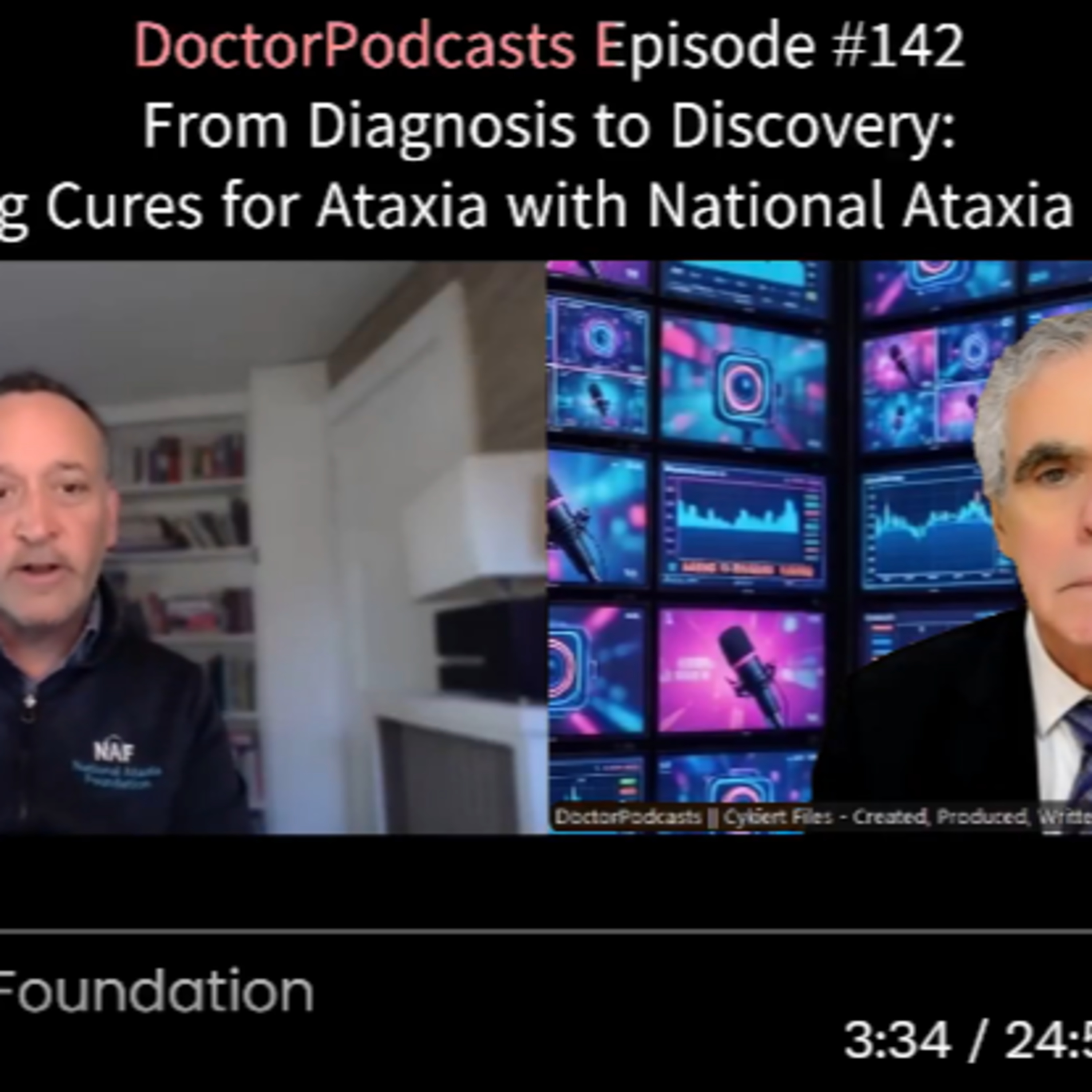
Ataxia: The rare neurodegenerative disease with decades-long difficulty getting approved treatments.
In this episode
DoctorPodcasts Episode 142:Watch http://Ataxia.org CEO, Andrew Rosen discuss patient & family support, research progress, regulatory hurdles and real world evidence for new clinical trials.Watch all 142 episodes of the DoctorPodcasts || Cykiert Files video podcast interview show with physicians, scientists, healthcare specialists, entrepreneurs and other experts. Please SUBSCRIBE & FOLLOW @DoctorPodcasts. Please LIKE, REPOST/QUOTE and SHARE the episodes. Send questions, comments, suggestions, reviews and messages to DoctorPodcasts. Thank you. Robert Cykiert, M.D.#AtaxiaAwareness
#RareDisease
#Ataxia
#RareDiseaseAwareness
#Neurology
#DoctorPodcasts
#MedicalPodcast
#PatientAdvocacy
#NeuroTwitter
#AcceleratingCures
#RareDiseases
#PodcastVideo
#HealthPodcast
#NeurologicalDisorders
#CykiertFiles
0:00 Hi, thanks for watching episode #142 of the Doctor Podcast show. I'm your host and creator of Doctor Podcast, Doctor Robert Seichert. We'd appreciate if you could please subscribe to and follow Doctor Podcast and also like and repost this and other episodes that you learn from. Today we're discussing an important but neglected medical condition called ataxia. That's a TAXIA. It's a disease that is debilitating and progressive for 10s of thousands of people in the USA and around the world. We're discussing it on today's program to bring it to the attention of the general public and also to get more attention from the various health agencies that have a role in helping patients, especially patients with relatively rare diseases and conditions.
0:50 Our great guest today to discuss Atax is an expert on this condition, and he'll explain what it is and what's being done to help people with this condition. And our guest today is Andrew Rosen. He's joining us today, and he's the CEO of the National Ataxia Foundation, or NAF. It's the leading nonprofit organization dedicated to finding cures for ataxia, which is a group of rare, inherited neurodegenerative diseases that progressively affect coordination, gait, walking, balance, speech, vision, and many other things.
1:26 Since taking the helm of an AF in 2019, Andrew has brought more than 20 years of nonprofit leadership to accelerate research and expand patient support and build hope for the ataxia community. He's got an MBA marketing from Wharton and also master's in International Studies from the University of Pennsylvania. And he's known for his collaborative approach and deep respect for the incredible resilience of people living with ataxia and their families as well. So Andrew, thanks very much for taking time and join us today to discuss this important medical topic, Ataxia.
2:03 Thanks, Robert. Appreciate that introduction. Really excited to be here. Great. So to start off simply, for our audience who may be hearing about this a toxic condition for the first time, can you explain exactly what it is and why it's often called a family of diseases? Yeah, so the word ataxia is a Greek word that simply means a lack of coordination. So you talked about some of the symptoms, right? A a classic first symptom for someone with ataxia is gait is their, their walking is off, right?
2:34 Their balance is a little bit off. So it's and, and the tricky part about ataxia is it's both a hereditary condition that really is the focus of us here at at the National Ataxia Foundation, but it's also a symptom of many other things. So for instance, if you get a concussion or if you have a traumatic brain injury or a soldier and, and, and an explosion goes off or even if you've had too much to drink, right, those are all you are going to show symptoms of the word ataxia. I sort of think of that as little a ataxia and then I think of the hereditary conditions, kind of a capital a.
3:10 The hereditary ataxias are what we call a movement disorder. So the big movement disorder that everyone knows, of course, is Parkinson's disease. And in some ways a taxi and Parkinson's are similar. ALS and Huntington, Huntington's disease are also movement disorders. And then there's a taxi as an, and I, you know, what one of the things we're really trying to do at NAF is make sure that the people with the taxi are, are, are known. Part of part of our real goal is simply awareness because we're not as well known as those other conditions.
3:39 We're trying to change that narrative, but that's really what a taxi is. As you mentioned, it's a family of diseases. There are over 100 forms so far, and they're finding more all the time of hereditary ataxias. So specific genetic mutations in the cerebellum that all fall under that that general term. There are both dominantly inherited ataxias and recessively inherited ataxias. If you remember your genetics one O 1 a little bit. And so and, and again, they're finding more as as as researchers discover new mutations, they're able to identify new forms of attacks.
4:14 And that's a really important first step because being able to give a specific diagnosis to someone is obviously critical and eventually developing treatments and hopefully a cure one day for the disease. Right. Is there any genetic testing available to to look for ataxia, the inherited varieties? There sure is, yeah. And in fact, there again, as as they develop, as they find new mutations, they can then develop a test for it. So you can test for specific ataxias. So for instance, if you know already that your mom or dad had ataxia, you can, you can test for the specific form if they've already been tested that you probably know what form you're going to have.
4:53 There are also panel approaches where a neurologist might say, you know, I, I think you're, you're showing symptoms of ataxia. We don't know which type. And then you can test in one, in one test for a range of ataxias. So the genetic testing component is really important. We have a, we have a free genetic counseling and testing program at any F that we fund. We think it's that important to be able to identify more people. And we know there are thousands of people out there in the US and many more around the world that have been told they have a taxi, but they still don't know what type.
5:22 And we're trying to kind of chip away at that, at that number every day all. Right, if we know the different types better, it'll be easier to customize treatments for a. 100%. Different types that you have. So tell us, what does the National Ataxia Foundation do on a day-to-day basis to support people living with this condition and the families of these people? Yeah. So you know, our mission is really twofold. We are working to accelerate the development of treatments and a cure while working to improve the lives of those living with ataxia.
5:54 So in some ways think research and support. So we have been providing funding for a taxi research for it's our 70th anniversary next year and it's been around for a long time. And through those years we've made real progress on the research from understanding kind of the basic mechanism of the disease to now much more translational work as we get closer to treatments in the clinic. We, so we, we give grants every year. You'd be hard, you'd be hard pressed to find an, A taxi researcher in the world doctor that hasn't received a grant from NAF at one time or another.
6:25 And, and obviously we're thrilled when some of those researchers go on to get larger NIH grants, set up their own labs and continue to work in the space. We, we sponsor the largest Natural History study in the Ataxias. We might talk about that a little bit later and we do a host of other things, sponsor the big research conferences, etcetera. And then on the support side, you know, we're really there to try to help people that are, are living with the disease. So we just came back last week from our annual Ataxia conference.
6:52 It's the largest gathering of taxi patients in the world every year. We had about 600 people in Orlando and other several 100 online. And it's a wonderful educational and really social conference to get them together. It's amazing how powerful it is when you let people know that they're not alone and that they don't have to explain what's going on to people. They're they're with people that understand them. We've got more than 60 support groups spread around the country and even globally. Many of those meet in person.
7:21 Some just meet virtually on Zoom. And then we obviously do, as you can imagine, a whole lot of stuff online. We, we have literally probably a dozen webinars a month on various topics of living better with a taxi or maybe a deep dive on a, on a research topic. So a lot of what we do is online. We're a small, we're still a small organization, but we've grown a lot. There's been much more interest in the attacks in recent years. And again, we might, we might go into that a little bit more later. Well, that's good.
7:46 And hopefully this program will give it even more attention and more funding and more research. So you provide research and you also provide physical as well as emotional support for the people who have this and their families. Exactly. That's great. Now can you explain what a specific form of this is? It's called spinal cerebellar ataxia or SCA and why certain types of SCA have been so frustrating for patients and researchers for decades. But I, I want to mention the, you mentioned the cerebellum.
8:19 The cerebellum is the part of the brain, it's sort of the back and bottom of the brain that controls our body movements. That's. Exactly right. So spinal cerebellar ataxia or SCA is the dominantly inherited forms of ataxia. What that means is if your mom or dad has SCA, each child has a 5050 chance of of getting the disease and it's independent for each child. So sadly, as you can imagine, what happens this, this disease can wind its way through generations of one family. And because ataxias of many of the ataxias tend to be sort of later on set, right, these SDA isn't normally considered sort of a pediatric disease.
8:57 There are certainly instances of that. But in general, often patients aren't symptomatic until their 30s, forties, 50s, even 60s. Then as you can imagine, maybe they've already had their kids and they didn't even know they had the disease, right? And so, so spinal cerebellar ataxia, we are up to now they just they name them as they find them. SCA one was discovered in 1993. So only, you know, a little over 30 years ago. We are now at SCA 52, I believe and they will continue to find more. I don't doubt it as the researchers continue to kind of those gene hunters continue to look.
9:35 One of the reasons that SCA is such a challenging diseases as I mentioned. So it's not only maybe later on set, but it's also very slowly progressing in many cases, not all cases, but most cases of SCA are generally slowly progressing. So unlike something like ALS, which sadly, you know, from diagnosis to to death is often five years, SCA's are much longer than that. They can be 20 or more years. And often people we kind of say will die with SCA, not from SCA, but because of it. It's slow progression.
10:08 It makes finding treatments difficult because you've got to a drug company has to prove of course that their treatment is effective and it's very difficult to run trials that last years and years and years. Patients don't want to stay on the drug that or maybe be on a placebo that long. Drug companies don't necessarily have the resources to invest in trials that go that long. The other tricky part I will say is that we we still are looking for sort of really good clinical endpoint. So you know endpoints that what what we're looking for with a drug that that can prove the drug is effective.
10:43 We haven't found great measurements yet in the Ataxias to prove that and it's made drug trials tricky I would say. Right, because it's a slow progression, there aren't clear endpoints. Exactly. They take a long time to actually notice and develop. So how? How is research speeded up recently and what role does the NAF play in in speeding that process up? Yeah. So I, I'd say a couple things. One, I mentioned that we sponsor the big Natural History study in, in the SC as Natural History is basically you're just you're, you're bringing patients in, we bring them in on an annual basis.
11:20 There are sites across the country and you basically are just measuring the natural progression of the disease, right? So from year to year, how are, how is the disease progressing in individual types of ataxia? And that data is so critical because if you're a drug company trying to prove that your disease work, your, so your treatment works, you have to prove that it's that it changes the natural course of the of the disease, right? So we sponsor that, we sponsor that trial. What happens in especially in rare diseases is that often, you know, these diseases can't sort of follow the traditional route of getting a drug approved in the US, kind of 2 double-blind placebo-controlled trials, right?
11:59 That's been the gold standard at the FDA for for decades. In a rare disease that's really tricky one, finding enough patients to do multiple trials. You know, these are diseases, individual SCA's might only have a few 100 known patients in the US. So it's difficult to do multiple trials and then also to ask a patient that has no other treatment available and they are progressively getting worse to potentially go on a placebo for a long time is really an ethical is a tough ethical question that I think is is a challenge.
12:32 So where I'm going with that is what companies can do is use the Natural History data that I mentioned as almost like a comparator set as a control arm for a clinical trial. And so that's one of the things that I think more and more companies are looking to. There is one drug for any type of ataxia that's been approved to date. It's for Friedrich ataxia, which is great. Friedrich is a particularly devastating form of a taxi that affects kids. So there was 1 drug approved in 2023. And the way that drug got approved was comparing the drug to their Natural History data set.
13:06 And so that's kind of a new, if you will, trend in the rare disease space. And so that's one of the things that that we are very focused on making sure that that Natural History data is really high kind of regulatory grade, if you will, that the FDA will accept. So that's one of the reasons that I think there's there's more hope out there. The other thing I would say is that because of some of the things that Congress has done, including the Orphan Drug Act back in the the 80s and some other legislation, it's made the space more attractive to drug developers.
13:36 You can imagine in a really rare disease and these are for profit companies, if there aren't enough patients out there, how can they possibly and it and it costs a lot of money to develop drugs. We've made it now more attractive and obviously that's a really good thing for our space. Right. You mentioned Friedrich's a taxi. That's the autosomal recessive form. That's a recessive form, exactly. They're both parents or carriers. They don't even know correct about 25% of their kids. And then each kid has a 25% chance.
14:04 That's exactly right. Right. So that that's very difficult. Now, Doctor Jeremy Schmahmann, he's an expert on a taxi from Harvard, recently gave powerful testimony at a bipartisan Senate hearing on how the FDA can sometimes slow down innovation and rare diseases. From NAFS perspective, why is real world evidence and patient centered research so critical for treatments and conditions like SCA? And how can you work with with the FDA to speed it up? Now, the FDA has a a tough job as well 'cause they have to prove a drug is effective, as you mentioned, they also have to make sure it doesn't have severe side effects and complications and wind up with more problems from the drug than than the condition.
14:49 So how do, how do we speed this all up? Does Doctor Shrumman have any suggestions or ideas? Yeah. So I was at that hearing with, with Doctor Schmalm and he did a wonderful job of representing our patient community. He's one of the leading a taxiologist in the world. So I'd say a couple things, as I mentioned before, you know, this idea of, of, of the gold standard at the FDA of 2 double-blind placebo-controlled trials that both have to be positive before they will approve a drug just doesn't work in the rare disease space.
15:21 And I think, I think there's been slow movement at the FDA over the years, but I'm still not sure that that that message that might be coming out from the top management is necessarily getting down to the review teams that are sort of used to what they've always done. So I think that's partly an education process. You know, I will say that you specifically talked about real world evidence and and sort of the patient voice in drug development. One of the things that that we have found particularly challenge challenging, disappointing with what's been happening at the FDA of late is that often when a drug is not, there's not clear evidence that it's either safe of effective.
16:00 But maybe there's debate within the community. The FDA will will, will form an ad, an advisory committee, an ad com, which is basically a group of outside experts. And then they'll let the the company, the sponsor of the drug present their data. They'll hear from the FDA about why they've got their concerns and then this committee can ask questions and then they basically vote, right. They make a recommendation to the FDA on whether to approve the drug or not that the adcoms have basically stopped in, in this sort of addition, if you will, of the FDA.
16:35 And what Doctor Schmahmann was talking about at that hearing was a specific drug that had received a rejection from the FDA, but that drug that the company had been told there would be an adcom because again, the data was the data could be looked at in multiple ways. It wasn't a safety question. It was an efficacy question. And they were told there was going to be an ad com And the company spent a lot of time and money getting ready for that meeting. And then the meeting was cancelled and the rejection was issued.
17:01 And by, by not having that meeting, one of the other things that happens in AD coms is that the public patients can actually speak about how their experience has been on a specific treatment. By removing that, you really remove the patient voice and the ability to let experts sort of battle it out. And so that's, that's disappointing. And, and we'd really like to see ad coms in cases where there's debatable data and in, in, I'll be honest, doctor and rare diseases. It's so rare that it's really clear whether a drug is effective or not.
17:30 We'd really like to see ad coms return and more of that. You know, the FDA talks about regulatory flexibility with rare diseases. We don't necessarily always see it when it gets to the review level. So that's that's really where we're we're focused, but I think. Isn't it true that the FDA can bypass the adcom or or ignore it and make their own decision? They can. They can, although it's rare that they do that. In most cases they follow. We would have just liked our, if you will, our day in court, right?
17:57 And that was that that wasn't given to us. And that's you can imagine for a for a patient community that feels like they've been largely ignored and people sadly attacks things always get accused of being drunk. As I mentioned, that's what their symptoms look like. It's a really it's a really tough disease to them not have the ability to get up and and and share with with the regulators. What that's like is is really disappointing seems. Like if the safety's been proven and if the debate is about efficacy, then maybe each patient should be given the option say, look, we're not really sure that this is going to work, but we know it's pretty safe from our studies and it's kind of up to you if you want to use it or not.
18:40 Maybe I'm I'm with. You I think it's a patient doctor decision. There's also the FDA also has other pathways they can offer sponsors, like for instance, an accelerated approval pathway where basically they will of a drug, but then insist that the company does post market, a post market study to make sure to really prove the efficacy. And if that, if that efficacy isn't there, the company will pull the drug off the market. But in the meantime, patients that have been in the clinical trial, for instance, who've been taking the drug and really think it's helping them are able to stay on it.
19:10 And that's the, that's the really hard part here too. Once a, once a company gets a, a rejection from the FDA, sometimes it's, it's nearly impossible for them to continue the program. So we'd like to see more. We'd like to see more of that from the FDA for sure. Right. I recently did a program on a drug for fatty liver disease where where that occurred. Basically the FDA approved it, but said we want data as time goes by just to be sure that it's really efficacious. Seems like that's a reasonable approach, no?
19:39 One wants ineffective drugs, right? I mean, no one does. So let's make sure that we gather the data, but let's do it in a way that is sustainable for the rare disease community. And we're not a taxi is just one of, you know, there's literally they think 7000 rare diseases already identified and they will find more and more this effects, you know, something like 30 million Americans. It's not so rare when you put them all together. And so we just need a regulatory body that that sort of evolves with with the science too.
20:06 Right are. There any drugs that are currently being investigated that might come to the FDA in the near future? Yeah, there are. As I said at our patient conference when I kicked it off on on last week, there's never been a richer pipeline in attacks to drug development than there is today and they can't come fast enough, right. And both of those statements are true. But yes, there is a, there is a again as deep a pipeline as we've ever had both in Friedrich ataxia and other recessive forms as well as in spinal cerebellar ataxias.
20:41 It it, we've got drugs in each phase of of drug development and many still preclinical, you know, compounds that are being evaluated. We try to fund and, and well, we try to make the space as easy as, as possible for drug developers to get in and we remove those barriers. So for instance, that really good Natural History data that I mentioned makes our space more appealing. And so we want to make sure that it's really good. We do a number of other things to try to, if you will, attract drug developers to the ataxia space.
21:12 What happened in the Friedrichs ataxia space once that first drug was approved just 2 1/2 years ago or so? There's a bunch more now coming. And that's great, right? We need, we say as a staff all the time, we need as many shots on goal as we can get. Drug development is hard. A lot of these will fail. We know that. So we need as many as we can get. But yeah, it's there's really, there's a lot of reason for hope out there. I just wish it could. It could happen faster, right? So we need cooperation and synergies between the government, the FDA, organizations like yours and as well as the drug companies that lose money by doing research and then having problems getting it approved.
21:53 Sounds like more cooperation and working together is needed there. That's exactly right. Right. What are some practical ways for our audience, people watching this? So whether they have a taxi or know someone who has it or just want to help, how can they get involved or support progress towards treatments and hopefully one day a cure? Sure. Well, let you know I, I, this will sound a little self promoting, but I think the easiest way is just become a free member of NAF, right? Just go to ataxia.org.
22:22 You give us your e-mail info and, and some other quick info and it, it really just allows us to e-mail you information. The neat part about we now have about 22,000 free members of NAF and about half of those are actual patients with ataxia. The neat part about that then is that if a drug company comes to us and says, boy, we'd really like to recruit patients with spinal cerebellar ataxia type 3, we can cut our database, right? We can go find out who's got SCA 3 and, and, and Matt match them up a little bit.
22:51 So that's a really quick way. We obviously do, we do a monthly newsletter. We, we announce our webinars or our conference dates, things like that. There's, you know, our website is chock full of, of educational information about a specific type. If you're newly diagnosed, how you might be able to find a support group or we, we, we have a program, we call them our aces. There are Ataxia centers of excellence. There are more than 40 now around the world. These are the leading ataxia clinics in the world.
23:18 We vet them. We make sure that they are worthy of, of being called an ace. But all of that information is available on our website. So I think that's, that's one of the easiest ways. The only other thing I might mention is, you know, we do spend a lot of time advocating for our community, right? Flat out, you know, advocacy work like many patient advocacy organizations like NAF do. In fact, I'll be back in Washington, DC and in two weeks with a with a group of rare disease executive directors like me pushing Congress for legislation that matters to our community.
23:50 So, you know, I would also say, you know, certainly if you're interested in supporting the community, keeping that those topics front and Center for your congressmen and senators, Congress people and senators is important. It matters. It does that that Senate hearing that you mentioned that Doctor Schmomman smoke at doesn't happen without just really good kind of grassroots level advocacy. And so trying to raise the profile of this disease so that, you know, more attention and more money can flow into the space.
24:19 That's great. So the best website isataxia.org, ataxia.org. That's it. All right. I'll make sure I post that on on this program so that it can go to it great. I want to thank. You very much for taking the time to tell us about ataxia and it's very important that the public has more information and knowledge about this and I think that will help eventually get treatment and cures and help these people and their families. Thanks so much for your. Time. Thanks for what you're doing, Doctor. It's really important.
24:52 My pleasure. Thank you. Take care.
 Apple Podcasts
 Spotify
 YouTube