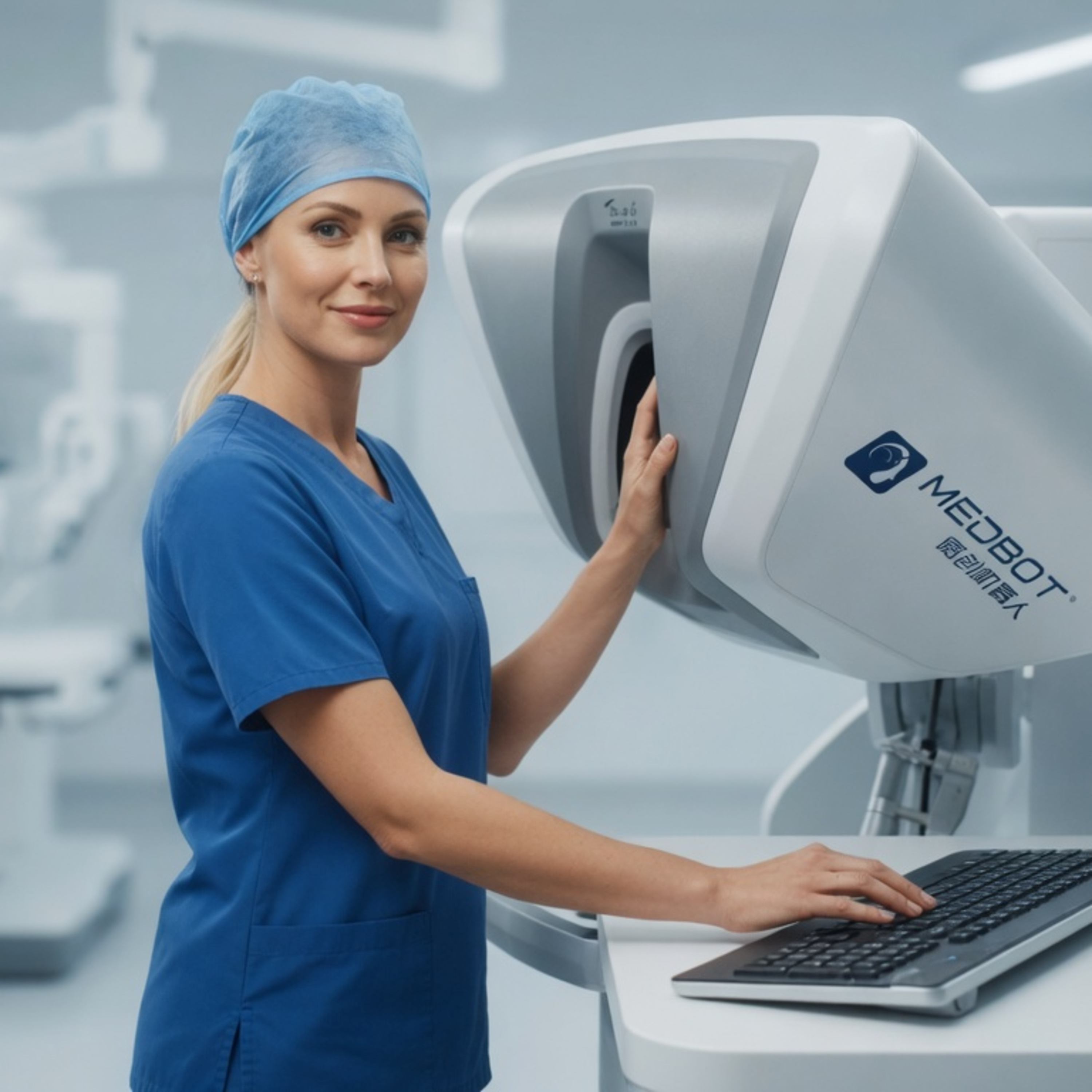
Surgeon operated on prostate cancer patient 1,500 miles away with a robot & only 0.06 second delay.
In this episode
This is the future of surgery. Access to top surgeons anywhere in the world for everyone. This will evolve in the next few years, as Elon Musk predicted: Robot surgeons will provide top surgery skills to people all over the planet.Watch all 141 episodes of the DoctorPodcasts || Cykiert Files video podcast interview show with physicians, scientists, healthcare specialists, entrepreneurs and other experts. Please SUBSCRIBE & FOLLOW @DoctorPodcasts. Please LIKE, REPOST/QUOTE and SHARE the episodes. Send questions, comments, suggestions, reviews and messages to DoctorPodcasts. Thank you. Robert Cykiert, M.D.#RoboticSurgery
#RobotSurgery#Telesurgery#RoboticUrology#FutureOfSurgery#MedTech#HealthTech#DigitalHealth#MedicalInnovation#ProstateCancer#Urology#Vodcast#MedicalPodcast#DoctorPodcasts#RobertCykiertMD#HealthcareInnovation#SurgicalRobotics#RemoteSurgery#AIMedicine#LongFormVideo
0:00 Hi, thanks for watching episode #141 of the Doctor Podcast Show. I'm your host, Doctor Robert Sichert. Please subscribe and follow Doctor podcasts and like and repost this and all your other favorite episodes. We'd really appreciate it. Today Doctor Podcast is going across the pond to London, England, where we're going to meet an amazing surgeon who has introduced incredible technology to his already astounding surgical robotic. Skills. Our guest today is Doctor Prokhar Dasgupta. He's a world leading robotic urologic surgeon and pioneer of robotic surgery in UK urology.
0:36 He performed the UK's first long distance remote robotic prostate removal, known as a prostatectomy, in early 2026, just a couple of months ago, and he was operating from London on a patient 1500 miles away in Gibraltar using the two main robotic system. He's a King's Health Partners Foundation Professor of surgery. He's the chair in robotic surgery and urological innovation at King's College London, and he's the chairman of the King's Vatakuti Institute of Robotic Surgery. He heads the Robotic Center of Excellence at the London Clinic and serves as the honorary consultant urological surgeon at GUYS and Saint Thomas NHS Foundation Trust.
1:18 He trained in both India and the UK. Internationally recognized clinician, scientist, educator and innovator with over 1100 research papers and major contributions to the surgical simulation and telerobotics. So Doctor Dasgupta, thanks very much for joining us today Doctor Podcast. We appreciate your taking the time to do this. Hello, thank you so much for having me. Yeah, it's our pleasure. Now for viewers who aren't medical experts, and most of our viewers are just the general public interested in reliable medical information, can you explain in simple terms what this ground breaking surgery was that you just performed and what part of the body was operated on and why?
2:01 So this was a historic moment, Auk First, where I was in an operating room in the London Clinic in central London, right here, and the patient was 1500 miles or 2400 kilometers away in Saint Bernard's Hospital in Gibraltar. I removed his prostate gland. This is a gland which every man has and his prostate gland had a cancer. So the intent was to remove the gland completely to cure him of the cancer. Traditionally, I would be with such a robot in the same room as the patient. The difference here was I was 1500 miles away and therefore this was Auk first.
2:47 A historic moment for us. That's amazing and incredible. Now what did it? Actually feel like to you sitting at the console controlling the robot from 2400 kilometers or 1500 miles away. Was it a different? Feeling than your usual surgeries with a robot. It felt almost as though I was there in the operating room in Gibraltar with the patient and my team who were there. So I do robotic surgery almost every day of the week where I am in the same room as the patient. But here the time difference between London and Gibraltar was only 66, zero milliseconds, sort of fraction of a second.
3:33 And this was achieved with a high speed dedicated fiber optic line and that reduced the time delay to 0.06 seconds. So it felt like I was in the same room as the patient and my team moving the robotic instruments from the console in London all the way to Gibraltar in real time. Wow, that's incredible. Now, before robots were used in surgery like this, how could doctors traditionally remove? A prostate gland for. Cancer What was the? Old open. Surgery technique like compared to the new robotic technique.
4:11 So I was trained during my residency in open surgery. So we used to make a cut at the lower part of the tummy. The patients would typically lose quite a lot of blood and stay in hospital often for up to five to seven days. So the recovery was longer. They have more pain until keyhole surgery and then keyhole surgery with a robot came along some 2025 years ago and that has completely changed the game. So for example, in the UK with prostate cancer, when I started doing this kind of surgery 22 plus years ago, only 1% of prostate cancer surgery was done robotically.
4:58 Today in this part of the world, that number has increased to nearly 95%. It's better for patients, tiny little holes, less pain. The patients are typically in hospital for a day or two. They hardly lose any blood. I can't remember the last time we have to give anyone a blood transfusion. So I think the recovery is faster and patients do better. That's incredible. Now, can you walk us through how robotic surgery first came about and when, when and where did it start? And what was the big aha moment that made doctors realize a robot could help inside the body?
5:33 So my own hospital where I've now spent 27 years of my career, guys, and Saint Thomas's was where it all started. And the man who started it was the late John Wickham, one of my heroes. And Wickham teamed up with Professor Brian Davis, who I met just last week of Imperial College London, not far away from where I am. And Davis was a mechanical engineer, and he, along with John Wickham, designed a robot called the Probot in the late 1980s, which could vaporize the middle of the prostate. So the prostate gland can become bigger and obstruct the water pipe in a man.
6:19 So this is like vaporizing the inside of the prostate, like cutting the core of an apple. So imagine making a channel in the middle so that a man can pee much easier, which often happens to men as they get older. And traditionally that was done with electricity and operation called durp, transurethral resection of the prostate. But Wickham and David showed that they could use the probot to map the inside of the prostate with ultrasound and then vaporize the middle. So that was the first such procedure, initially in a lab and then in the same operating room where I now operate at Guy's Hospital.
6:57 And that was in the early 1990s. I then met a another pioneer called Lukusi who had a deep influence on me at Hop Johns Hopkins in the late 90s. I had a scholarship to go and see him and he was using a voice control robot called ESOP. And we then performed the words such robotic surgery. The first such a randomized trial between London and Hopkins in 2002 where we used a robot with, in those days what was called ISDN lines. No users anymore. These are all telecommunication lines, but they were the best available where the machine, the robot was in London and was controlled by Karusi and his team all the way from Hopkins in Baltimore.
7:44 And that showed for the first time that the robotic arm was less, was more accurate than a human hand, but slower. So that was the first such evidence to show that robotics was more accurate. And then came the da Vinci system, amazing Rolls Royce in the world of robotics. And that brought in three DHD vision from a console, tiny little robotic arms without any tremors. So even if the surgeon has a little bit of tremor, the arms are completely filtered of such tremors. So find a way of doing surgery.
8:25 And initially, the da Vinci system was brought in for heart surgery, cardiac surgery, but prostate cancer is where it really took off. My team and I have used every possible version of the da Vinci in the last 20 years. Now it has spread to other specialties like, say, gynecology, lung surgery and even surgery through the mouth. There are now, after 20 years, new robots in the market. There's a British robot called Versias. There's a European robot called the Hugo from Medtronic. There are a number of Chinese robots, Japanese robots and even India has its own Made in India robot called the Mantra.
9:07 So the market, having been led by the Da Vinci for 20 years, is now expanding, with other companies coming in and bringing their own versions of robotic surgery. Wow, amazing. Progress. So we went from a surgeon standing right next to the patient with a robot to you operating from 1500 miles away. What key technological breakthroughs made that remote telesurgery possible? We've heard of telemedicine, where doctors talk to their patients. But now we have. Telesurgery what? What new technological advances made that possible?
9:43 So let me make this simple for your viewers because the concept is complex. In 2001, the first such remote operation was done from New York to Strasbourg to remove a patient's gallbladder. The gallbladder is here in the right side of the tummy and a small gland which can get very painful and inflamed and we have to remove it by Geo surgery. So that was with a robotic system called the Zeus, which when the da Vinci came was taken away from the market and no longer existed. So that was Tele surgery compatible.
10:23 The one thing then happened was that the da Vinci wasn't. So we couldn't continue with doing Tele surgery for 20 years because try as much as we did, we could not remotely move the arms. For example, I remember Doctor Menon, again, one of my gurus and heroes from Detroit who was doing robotic surgery in the early 2000s. You know, and I, I was influenced by him deeply. He and I tried to see if we could move the da Vinci arms from London to Detroit and vice versa, and we couldn't. We it just was not compatible.
11:04 What has now happened are two things. 1st, the new robots, a number of new robots, not all of them are Tele surgery compliant. It means that the delay in the robot has itself reduced. So there's a delay between the vision and the hands of the surgeon and that has been reduced by improving the computer vision. So that's one. The second is that we have fiber optics and 5G connections, which we didn't have all those years ago. Fibre optics are one of the greatest inventions of mankind and they're there all over the world.
11:42 You can now have a connection, say between London and Gibraltar or indeed other parts of the world, which are called virtual private networks. This is like having a tunnel where no one can hack in. So these are 99 .9999% accurate. So this whole business of what happens if someone, if there's a cyber attack, well, it's almost impossible to hack into these lines. And even if that happens, artificial intelligence through other networks can reroute the connection to other networks. There is also a 5G backup which is ultra low latency and as you know very economical.
12:27 So I think there are two parts that have changed. First the technology, the robots themselves have become Tele surgery compatible, which wasn't the case. And the lines in between the machine, the console and the patient who is remote is now through fibre optics and 5G which has been the two game changing technological advances making this possible after 20 plus years. Wow that's incredible. So you're 90? 9.99% sure that you're going to have. A stable, reliable connection. To the robot. During the surgery, right?
13:01 That is correct. In fact, let me reassure your viewers even further. I wrote the commentary to a trial in the British Medical Journal just published last month, and the commentary is called Telesurgery 2.0. What I'm trying to say is telesurgery has returned after a very long hiatus where we almost forgot about it. But in that I describe a trial where half the patients had telesurgery and the other half had surgery where the surgeon was in the same room as the patient, which is traditional robotic surgery.
13:37 And it will come as a surprise to you that the only robotic failure actually happened in the traditional surgery arm. So the only time the machine failed was in the traditional arm. It never failed in the telesurgical arm. So I think we can be as secure as we can be with the technology. Nothing in life is 1000% right, but I think we are pretty much there. Wow, that's incredible. Now, why did you choose Gibraltar specifically and. And what does? This mean for patients. Who live far from specialist hospitals and can't make it to London.
14:15 So Gibraltar is actually a what we call a British territory. So Saint Bernard's is the main hospital there and it is a National Health Service hospital or NHS hospital. So it's the same as the rest of the UKNHS and the patients there are entitled to NHS treatment free at the point of delivery because Gibraltar did not have complex surgery provision until now, no robotic surgery at all. These patients have traditionally travelled from Gibraltar with their families, sometimes multiple times to London to see me and my colleagues and then have had to travel back and back and forth to have surgery, often staying in hotels for up to three weeks.
15:03 So when this was offered to the Gibraltar Health Authority and mind you, it has taken us a year to plan it. So it's, it's been a long journey. You know, it's not surprising that both the politicians there accepted. The clinicians were very excited. Once the legalities were done, the actual people who made it happen were the patients. So I'm grateful that the patients put their faith in US and they decided that they would have robotic surgery while staying home rather than travel all the way to London.
15:38 Wow, that's great. Very important and huge benefit to the patients. Now, looking ahead, do you see robotic? Surgery. Changing healthcare. For people in rural. Areas, small towns or or even different countries could the best surgeons. Literally be available. Anywhere you could operate anywhere in the world. As long as you get the politics and legalities out of the way, right? The short answer is yes, I do. But let me expand on that a little bit. You said the politics and the legalities, otherwise known as the governance, and we've learnt a lot of lessons from it.
16:17 Let's not forget that the law is different in different parts of the world. I mean, in the United States, for example, the law is different in different states, right? You, a surgeon cannot just say tomorrow I will operate on a different state. It just does not work like that. So I think the getting the ethical, legal and social issues right is vital. We are not at a point, even if we would hope that we would get to that point at some stage where it is just plug and play. We have a tablet and we just press.
16:48 I will operate tomorrow in say you know, Alaska and then day after let me switch to somewhere in Mumbai and then to, you know, while you could imagine things like that, I think the law being different in different countries and the trust of patients being different in different countries because of different people is something we must keep in mind. The doctor patient relationship is vital, but the humanitarian value of this is immense. Imagine there are nearly 5 billion patients who do not even have access to the most basic surgery.
17:26 Forget robotic surgery for a minute, but they do not have access to the most basic part, some in rural areas who have to travel for hours and days just to get to a hospital. I think this could be a game changer. And this has not just happened in the UK, in China in remote areas, for example. This is happening. There is India is doing this with their own made in India robot. It's happened in the Middle East and Europe. And recently there has been an FDA approved trial from Florida all the way to Angola in Africa, which was cholera stricken for a period of time last year and has a very large incidence of prostate cancer.
18:12 So imagine this as a humanitarian benefit to those patients in that African nation. So I think it has tremendous potential, but we would need to do it in a trustworthy and responsible fashion, right? And that takes time, but that that takes time. I mean, for example, indemnity, you know it, it took us nearly six months to sort out the indemnity to do this between the London Clinic and Gibraltar, six months because the traditional indemnity companies were not willing to cover the programs if say something goes wrong, there was no cover.
18:50 So it took us six months to get special indemnity to do this. And that would vary from country to country because you do not want to put the surgeons and the patients and the health systems at any risk. So I think there are a number of very, very important things around the operations which are probably as important if not more important than the surgery itself right now. Do the surgeons doing this this? Telerobotic surgery need special training or are you training younger surgeons? To do this, we through the Society for Robotic Surgery, which is an international organization, we have been discussing guidance for this is for preparing such guidelines within an international body.
19:45 Yep, So that this can apply to whichever part of the world that we live in. And part of it is training. So most of the Tele robotic surgeons are trained robotics. So that part of training where you do some e-learning away from the patient, then go into a simulation lab. Then perhaps, perhaps do some cadaveric work and then have a mentor showing you what to do until you're competent and signing you off is standard of care. But then with Tele robotics comes this entire whole spectrum of ethical, legal and social issues.
20:26 Having to adapt to the time lag, however short that might be. Because the longer the distance the time lag becomes, the longer ideally should be less than 150 millisecond. So those adaptations and training for that, what to do if that unfortunate and impossible event of the line failing or the machine failing happens? For example, having someone who is competent may not be a world expert, but competent and who could finish the job at the other end so that the patient is not affected is also important.
20:58 So yes, there will be programs of training as telesurgery evolves over the next few years, right? We, we still have ways to go. Have you done additional cases? After this first one. That you did, yes. Yes, this is actually a program of work. It was not about showing feasibility and saying this can be done. That was not the point. The point was a program of work. As I told you, we had done this kind of work in 2002, but then the technology faded. So for us, this will expand from prostatectomy, prostate cancer surgery into women's surgery, for example, hysterectomy and then into bowel surgery.
21:45 And this will happen between the London Clinic and Gibraltar over the next year or two. And then we are hoping that this will expand into other territories, perhaps Jersey and other smaller populations who do not have access to this kind of technology, right? Have you considered teaming up with Musk's Starlink? Because that has access to just about every rural corner of the planet. And my understanding is it's a very high bandwidth and highly reliable network for this. So I haven't been in touch with Starlink myself for this purpose.
22:25 We however, the whole idea of low trajectory satellite hasn't really been as good for this purpose as say fibre optics with a 5G backup. So if you look at the literature, yes, the the concept of low flying satellites has been brought up but hasn't really taken off. I think it will. The tech is there, I think it will. But we have done something else. So at a European conference last year, which we hosted in London called the European Robotic Urology Symposium of ERAS, I chaired a section on space surgery.
23:12 Very topical with what's happening currently with the Optimist mission. You know, so the inspiration from that came because I had helped with the PhD thesis of a NASA scientist and she and I got really interested in surgery in space. What happens if something happens to them today? You stabilize them and send them back to Earth, which may not be good enough if you're going to have moon missions and ultimately Mars missions. That has been talked about. So, you know, putting a hotel on the moon is OK, but if there's no medical backup, then it's not a great idea.
23:50 So the two space stations currently are about two, 5300 miles above the International Space Station and the Tiangong Chinese Space Station. So we teamed up with NASA, the Space Surgery Association and the UK Space Agency and I had experts come in and a cloud system from Alibaba and connected from London to the cloud, as you can imagine, right up to the station and to Singapore, some 10,000 miles away. And we sent up into the cloud a three Dai generated model of the prostate, which is something I use when I operate on patience.
24:36 I have a patience 3D printed model. So we sent that up and in real time in front of a live audience, controlled it from a iPad, moving it from London to the cloud into Singapore with hardly any time lag. So I think the cloud technology is has a very, very bright future for this and in fact a machine AUS robot which weighs only £2, you can literally post it on a Amazon cardboard box called Space Myra. Mira has already been sent up to the International Space Station and controlled from Earth to cut rubber bands.
25:18 Admittedly, the time delay was 600 milliseconds, but now with this kind of cloud technology, eventually it will become 6G or we call 6 GI. Think even that connection into the space of moon with surgically is 1.5 seconds away is not unthinkable. And I think if we are to have these missions, I'm sure the space agency all over the Earth, all over the world will have to think about how we provide medical care should something go wrong while these folks are in space, right? Yeah, if you're on a trip to Mars and three or four months out something happens, you you might be the first surgeon to do a surgical procedure on somebody halfway to Mars.
26:05 It would, it would be a privilege if that I was given that opportunity. But I certainly know having worked with these amazing people last year, last September, and you know, that also took a year and a half of planning to get it to that point for a live demonstration. I certainly know that the technology exists in order to be able to provide that care in space, should that be necessary. In fact, if you're, if your audience are interested, let me you know, bring highlight an article which has just been published in the British Journal of Surgery by my team on space surgery.
26:43 And, you know, at least the lay audience would enjoy reading the short abstract as to what the challenges are and what we need to do to make this happen. That's great. Now, you mentioned AI several Times Now. How's AI going to impact robotic and telerobotic surgery? Will humans eventually be out of the picture completely with, for example, Leon Musk's Optimist robot becoming a better surgeon than you or doing better cataract surgery than I do? I'm an ophthalmologist. Are, are we going to be eventually replaced by robots who can do better work than we?
27:20 Robert, you and I can be certain that that's not going to happen in a hurry. I, I, I don't know what you think, but that's, that's what I think. Some, some of my colleagues think that I'm wrong. But having been in the think of it and working on automation ourselves, I think that these machines, these intelligent machines are there to augment our performance and not replace us. So I had the great pleasure of leading two major programs in health. I mean, these are wider programs. One was called the Trustworthy Autonomous Systems, which we started during COVID and more recently something called Responsible AIUK, which is actually an international ecosystem.
28:05 And you know, part of it was looking at what is currently happening in the automation space and what we are doing ourselves. So the levels of automation go from zero to five. OK, so zero is no automation. The da Vinci system that I mentioned and most of the machines that are currently doing robotic surgery are level 1. And we have a water jet robot which can do what I described with Wickham and Davis all those years ago in the late 80s and early 90s, create a channel in the middle of an enlarged prostate.
28:42 And that machine is called the Aqua beam or hydros. And you can mark out the middle of the prostate with ultrasound and it will automatically with the water jet create that Channel. So that is Level 3. So there was no level four or five full automation. That is until recently when again Johns Hopkins Hospital, with which I've had a long association, came up. Hold on, hold on. I'm back with you. Sorry about that. You can edit that problem. I'll just edit that out. Yeah. So can you hear me? Yeah, I hear you.
29:29 Well, and see you well. Just hold on a minute.
29:42 This is the problem of the phone, because someone calls you and gets interrupted, right? So I can barely hear you, but I think we are nearing the end. So as long as you can hear me, it's fine. So there has been no level 5 automation until recently when Johns Hopkins brought out a machine towards the end of last year which can remove the gallbladder in pigs with 100% accuracy and again using algorithms to train this machine. So five days after this report, I was at the place in the UK where engineering really happens.
30:26 It's called the Royal Academy of Engineering, and they were about to make me an honorary fellow. This was a significant honour because there is only one other surgeon who is a fellow. So I'm not an engineer, but I've worked with these folks and friends for a number of years. So I was addressing a group of group of public and patient patients in a public facing summit. So this was in London and as this had just gone, I said to the people who are gathered hands up, how many of you would have this surgery with a machine that can remove pigs gall bladders with 100% accuracy, no mistakes and just a single hand went up, one hand went up.
31:19 So I said I had my I had my answer immediately. So I asked them, I asked the public why is it, I mean look, it makes no mistakes. They said well look, we the answer from us is 2 words. Not yet. And actually there was a cartoonist who was drawing the proceedings. And this cartoon is publicly available on my LinkedIn post in the background where there is this cartoon of a patient being operated on by a autonomous robot with the words not yet. And the public are saying, look, we are willing to be part of trials, so we are willing to help you test this.
31:52 But we want a human in the loop. We want that empathy. We want a human being in control. We don't think a machine can completely today replace a human being. The only person who put his hands up was someone I went to during lunchtime and I said you're a brave man. What what were you thinking? He said, well, I'm not just brave. The reason I put my hand up is because my father died when he had a keyhole cholecystectomy, so got back the removal. So I I'm not willing to have a human surgeon make an error on me when this happens to me.
32:26 So this is a lived experience, but that is a lone voice. And what that event taught me was just because we can do something with AI surgically does not mean that we should do it. Particularly if we do not take the public and our patients with us and bring in that trust and responsibility element. I think we are setting ourselves up for failure. So in my view, the text certainly exists in some labs in the world, including our Rome, where say for example, you can automate the suturing with more accuracy.
33:01 But I think for complex surgery where you really need diverse data and a lot of that to achieve full automation and have the patients trusting you is miles and miles away. And as a surgeon myself, if I fell I'll, I would love to be able to look into the eyes of the person treating me and say to them, look, I trust you and you don't. I don't think you can look at the eyes of a machine and say I trust you. So I think Robert, you and I, at least where my brain is concerned, are going to be OK. I think the patients still need us.
33:43 And I think that's the way I see the future, right? So not yet makes perfect sense to me. I agree with you. I I want to thank you. Very much for taking. The time to do this program with us, I certainly learn a lot and and people out there watching this will have also learned a lot about telerobotic surgery and and surgery in general and have learned where Healthcare is, is going. And I want to thank you also for being at the frontier and and moving this ahead because I think it will benefit patients all around the world.
34:21 So thank you very much Robert, thank you so much for inviting me. I hope you viewers and listeners will enjoy this and if you have any questions just come back to me. I'm usually available on social media and I can respond to you. Great. Thank you.
 Apple Podcasts
 Spotify
 YouTube