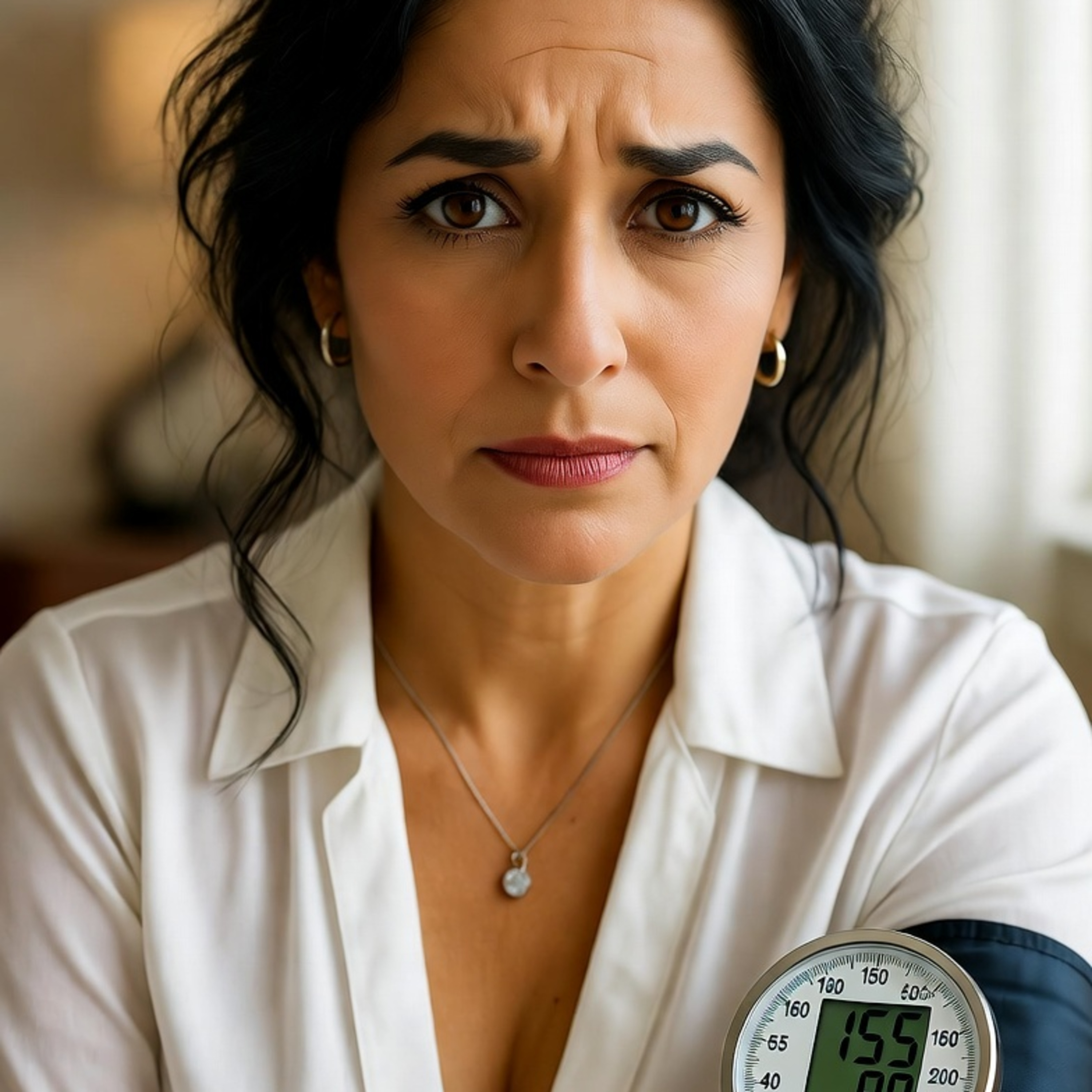
Got high blood pressure? Here's how to get it down!
In this episode
DoctorPodcasts || Cykiert Files EPISODE 125:What if your blood pressure spikes only sometimes & the real trigger is an emotion you don’t know you’re hiding? Samuel Mann, MD, Professor @ Weill Cornell Medical School, hypertension ninja, & author of "Hidden Within Us" explains:❓ Why many BP checks at doctor's office are wrong🏃♀️Lifestyle fixes that actually drop BP - no meds⚙️Why current guidelines ignore individualization🚀New drugs coming that could change everything Watch all 125 episodes of the DoctorPodcasts || Cykiert Files video podcast interview show with physicians, scientists, healthcare specialists, entrepreneurs and other experts. Please SUBSCRIBE & FOLLOW @DoctorPodcasts. Please LIKE, REPOST/QUOTE and SHARE the episodes. Send questions, comments and messages to @DoctorPodcasts. Thank you. Robert Cykiert, M.D.#doctorpodcasts
#RobertCykiertMD
#cykiertfiles
#Cykiert
#SamuelMannMD
#DrSamMann
#HypertensionSpecialist
#ResistantHypertension
#ParoxysmalHypertension
#EpisodicHypertension
#MindBodyConnection
#RepressedEmotions
#HiddenEmotions
#MindBodyHealth
#HypertensionCauses
#BloodPressureCheck
#BPMeasurement
#AccurateBP
#OverreadingBP
#LifestyleForBP
#LowerBPNaturally
#HypertensionControl
#BPControlRates
#IndividualizedTreatment
#HypertensionMedications
#BPSteps
#NewHypertensionDrugs
#HypertensionGuidelines
#BeyondGuidelines
#WeillCornellMedicine
#AmericanSocietyHypertension
#ASHCertified
#HiddenWithinUs
#BeyondConventionalMedicine
#MindBodyPodcast
#DoctorPodcastsInterview
#HighBloodPressure
#EssentialHypertension
#SecondaryHypertension
#EmotionalHealth
#ChronicIllnessLink
#HypertensionMyths
#BPManagement
#PersonalizedMedicine
#HypertensionExpert
#MedicalInnovation
#HealthPodcast
#WellnessJourney
#BloodPressureTips
#HeartHealth
#Cardiovascular
#InternalMedicine
#ClinicalMedicine
#HypertensionResearch
Hi, welcome to episode #125 of the Doctor Podcast, Sicard File Show. And as usual, I'm your host, Doctor Robert Sicard, and we appreciate you tuning in and watching. Please subscribe to Doctor Podcasts and also like and share this episode with your friends and repost it as well so that more people get to see it and so that we get more great guests in the future. Today we're discussing an extremely important topic and that is the subject of high blood pressure, also known as hypertension. High blood pressure is a big medical problem in the USA and and basically the the entire world.
According to the CDC, the latest data from a couple of years ago, about 50% of adults in the USA have elevated blood pressure, which is usually considered above 130 / 80. And we'll talk about that number and why that's important and why some people think the number should be differently. High blood pressure is one of the leading causes of of death and disease in the USA. It's it's probably a leading cause of heart attacks and strokes and it probably causes somewhere around 600,000 deaths per year in the USA.
So it's it's an extremely important problem that needs to be managed better. According to the CDC, only about 25% of patients who have high blood pressure actually manage their blood pressure properly and as a result they have other diseases and conditions. Now to discuss high blood pressure, we have one of the leading experts on the planet on this subject, Doctor Samuel Mann, who is very kind to join us today to discuss this topic. Doctor Mann is a board certified internist and hypertension or high blood pressure specialist.
He's a professor emeritus of the clinical medicine at the Wild Cornell School of Medicine here in New York City. He's certified as a hypertension specialist by the American Society of Hypertension. He specializes in optimizing hypertension and also treating high blood pressure through individualized approaches with special expertise and resistant hypertension that doesn't respond well to the usual medications, and also episodic hypertension where some people have occasional spikes of their blood pressure and at other times it may be close to normal.
He's also pioneered a new understanding of the mind body connection, uncovering a relationship between emotions that have been repressed and are hidden from our awareness and a number of other medical conditions related to high blood pressure. And we'll talk about that some more in detail. Doctor Mann has published over 60 scientific papers, numerous book chapters on the subject, and he's also written his most recent book, Hidden Within Us, which is about the mind, body connection and high blood pressure.
Great book. He's also starting a podcast called Beyond Conventional Medical Thinking, which I'm looking forward to seeing because he has expertise in this mind body connection and other things that really aren't discussed much these days. So Doctor Mann or Sam, thanks very much for taking the time to join us today on this Doctor podcast episode to discuss this very important topic. We appreciate it. Thank you. Pleasure, Yeah. So tell us what causes hypertension or high blood pressure and what's the definition of high blood pressure?
I know the the standards and criteria change every few years and many of my patients as an ophthalmologist are sometimes confused as to what their blood pressure should be. Thank you. Well, first of all, defining what blood pressure is, what level, well, actually the cause of high blood pressure, there are many causes. The word we usually use is essential hypertension, meaning there's no specific cause such as an endocrine cause or a narrowed artery to the kidney. Those are secondary hypertension.
We're talking essential hypertension, which is 95% of the population. So what causes it? Certainly genetics play a role, certainly weight, diet, and it's interesting when you look at evolution, if evolution is to our advantage, very often the natural diet in a primitive environment was not high in salt like it is today. It was low in salt, and particularly in a hot climate. Somebody who's genetically programmed to hold on to sodium, to hold on to salt, is Advent. It's his advantage in survival. Then you take that person and bring his descendants to a society where there's a high salt intake.
That evolutionary advantage we now call a hypertension gene. So evolution is funny in that way. In the same way, genes that enable us to survive famine over millennia, then what we can call those genes, obesity genes in a society where there's so much excess food and calories. So there are genetic factors such as salt, there are hormonal factors such as the urine and angiotensin hormonal system by the kidneys, which also cause high blood pressure. And it's interesting, they have the 2025 guidelines about hypertension, defining it and treating it.
And I don't like those guidelines because they don't break it down. So you can individualize treatment and we can individualize treatment. We have to do that. And I look at hypertension, essential hypertension is mainly 3 causes, one sodium volume salt related. The second, the hormonal system, the renal angiotensin system, often governed by the kidneys. And then the third less common cause is related to the sympathetic nervous system. And that's another whole discussion. Well, what drives the sympathetic nervous system?
And we can talk about that. So those are the main causes. Your second question was about how do we define it? And we do define it by the numbers. And some people used to say 140, some people say 130, some people say 120. My answer, I'm not sure. There was a study, I think it was the Sprint study, which looked at the outcome. They divided the patients enrolled in that study into two groups. One group was given medication to drive their pressure below 140, the other group below 120. And the group that was pushed to below 120 did better in terms of outcome, cardiovascular and all that.
The problem with that study is a bigger number of the patients who were below 140, actually their pressure was above 140 where you didn't have that in the 120 group. The second problem is most of the benefit probably came getting it from above 140 to below 130. I would have been interested if they'd compared 1:40 and 1:30 and getting it below 120 into the one teens. You run into more problems with side effects, dosage of medication and and symptoms if the pressure is too low. So my definition would usually be wanted below 1:30.
If it's an 80 year old and they're in the one 30s and they're not high risk, I might cautiously treat them further, but 1:30 is a good number to go by. But there's no exact answer. So 1:30 sounds like a good number, but could you explain the difference between the 1:30 and the 80? The In other words, the systolic blood pressure and the lower number is the diastolic. Could you explain what that is to the audience? Systolic pressure and outcomes generally correlate with the upper number of The systolic is the blood pressure when the heart is contracting and pushing blood into the vascular system and it pushes the pressure up within the arterial system, that's the systolic.
The diastolic is between heartbeats when there's no pumping of the blood, and it's the pressure at which it settles in between consecutive heartbeats. Interestingly, one could ask, are you better off if you have a pressure of 140 / 90 or 140 / 70 And the answer? Interestingly, yes, 140 / 90 I would treat. I wouldn't settle for leaving it at 90, but I feel good about it because I know I can bring it down. Whereas when it's 140 / 70, the difference between the systolic and the diastolic increases, reflecting stiffness of the arteries.
So that's why a lot of elderly patients may have a pressure of 160 / 70. So it's called the pulse pressure, the difference between the systolic and the diastolic. So for example, I think a patient's better off if his pressure is 160 / 120, then if it's 160 / 60, assuming that I can successfully lower the pressure to normal. But I think there's less arterial stiffness when the pulse pressure is not that wide. But what about somebody who's, let's say 140 / 60? If you treat that 140 number the systolic, won't their diastolic go down too low?
You would think so. I don't think it's that well understood. And again, there can be another reason for the low diastolic. So now we're getting into Physiology. If you have somebody who, let's say, is very anxious and the adrenaline is flowing, it dilates the arteries and you can get an increase in that pulse pressure at 140 / 60, that'd be another cause for the bigger pulse pressure. And that's why you want to measure pressure at when a patient's in a normal state. And some of that we it's still guesswork.
So 140. It also depends on the age. If it's 140 / 60, the answer is I want them to measure it at home and not rely totally on the pressure in my office. And I'd also consider doing a 24 hour monitor. Let's see what the pressure really is over 24 hours before making a decision on medication that this guy's going to be taking for years. Right, interesting. Now, can you explain you got into a little bit. What's this white coat? Syndrome. A lot of my patients tell me that when they go to a doctor, the blood pressure is very high, and then they go home a few hours later and it's low.
Is that this mind body connection? Is it nervousness? Are they secreting a lot of epinephrine because they're nervous that their blood pressure might be up?
It's a few things. First of all, there are two reasons why your pressure might be higher at the doctor's office than at home. 1 is you're nervous about your blood pressure. Your heart rate may be a little faster. It is related to anxiety, increased epinephrine, adrenaline, and it's transient. Whereas at home you might be calmer about it. And that's classic white coat hypertension. And again, why it's important to follow your pressure at home as well. Then you might ask, well, are there people who they don't feel nervous, but their pressure is much higher at the doctor's office?
And the answer is yes, that can happen too. They'll swear they're not, they're not upset, they're not nervous. And yet their pressure goes up when they see me or not just me, any doctor and lower at home. So that's why it's important to check in at home. The other problem, which unfortunately is very common, is in most doctors offices, they call you in, sit you down and check your pressure. Every guideline says to wait 5 minutes, sit down, put on the cuff, sit for 5 minutes, then measure it. So if your pressure is higher than it should be and they didn't give you 5 minutes to wait, I I think you should request that they do that.
You cannot be sure of that number without the number, the five minute wait that every guideline recommends, and there's no quarrel about that. Right, because activity causes the blood pressure to be elevated. So if you're rushing to the doctor's office and they check it right away, it's going to be high. I mean interestingly, weight lifters when they lift weight or actually even others. Besides weight lifters, when you lift weight, pressure can go up to one 8200 transiently and that's part of normal Physiology.
It's not sitting at 180 for hours and hours and hours, but does go up in the midst of anxiety in the midst of. Physical strain, right? So during exercise, for example of running or biking and other physical activities, your blood pressure actually goes up. But it's OK because it's just transient for half hour or a few hours. It's not there all day while you're watching TV, is that right? Right, right. So that that's important. Now, would you, based on what you just said, should everybody have a blood pressure monitor at home?
We all have thermometers at home and check our temperature when we're not feeling well or have a cold or a sore throat. Why shouldn't everybody have a blood pressure cuff at home? They're pretty inexpensive. You can get them for about $30.00 in a drugstore. 30 no. 40. Under 100, under 100, I I thought I saw some inexpensive. If your blood pressure is always normal, no, you don't need one. If it's borderline or if it's elevated, then yes, I would agree. I think everybody should check it at home because you don't want to rely on a check at a doctor's office once in four months.
You want to be able to check it more often, and you can do it at home and again at home. Sit down, feet on the ground, arm on a table, put on the cuff, sit for 5 minutes and then take two or three readings a minute apart. How often should you do it? It depends on how high the pressure is, how much medicine. But you know, if your pressure is reasonable, you might check it once in a week or two. If you're on medicine or changing medicine, you might want to check it every other day or even temporarily every day if if there's a big rise in blood pressure.
One thing I would argue against is don't check it three times a day because checking it three times a day, you will create your own white coat. Hypertension at home, at home. And I do have some patients whose pressure is normal in my office and higher at home because they're nervous and they check it and check it. Now, what age should people start checking their blood pressure? First answer is I don't know. I would imagine, well what age should somebody have an annual checkup every year or two? And I guess at that checkup it should be checked.
And again, it depends if it's perfectly normal, once in a year or two is fine. If it's borderline then maybe recheck it in a few months. What about if you're overweight or if you have a family history of high blood pressure or heart disease or diabetes? Would you recommend checking it more often? Because if you have a combination of diabetes, being overweight, you're more likely to suffer medical consequences from high blood pressure. No True, Although again I I think the answer depends on what your blood pressure is running.
If if you're overweight and have a family history but your pressure is 120, maybe you want to check it every six months rather than every year. And there's no absolute right or wrong, but if it's perfectly normal, that's fine. If you have those risk factors and it's borderline, then you want to watch it at least maybe once every one or two months and see the direction it's going. Now you mentioned one of the causes was this renin angiotensin system, which is controlled by the kidneys. Why? Why is there a problem with that?
And is it genetic or is it environmental? Is it food we're eating or what are the causes for that? Nobody fully understands what is the cause of an increased renin, which is the hormone. I'm sorry. It's the enzyme that stimulates the production of angiotensin and angiotensin raises blood pressure and medications like the ACE inhibitors like vaso, vasotec, lisinopril or the angiotensin receptor blockers, the Arbs, the Arbs like valsartan, telmisartan, they all block that renin angiotensin system.
Why it's elevated, it may be genetics, and I don't think it's clear, but if the system is on OverDrive, it will raise your blood pressure and medications that target that work beautifully if that's what's driving your blood pressure, right? So you could have normal kidneys otherwise, for example normal BUN blood test, creatinine blood test, but for some reason your your kidneys producing too much renin right? And the kidney function will remain normal for a long time. But if you have pro a long history of hypertension or more severe hypertension, then it damages the kidneys, you get protein in the urine and you get gradual diminution of kidney function.
Now what about salt intake? You you mentioned that as as one of the causes. Seems to me like we should be cutting down on the amount of salt we're eating. Is that right? It depends. As somebody who's genetically programmed to hold on to salt, yes, a high salt diet will raise their pressure. Reducing salt intake is very important in controlling the hypertension and in reducing the amount of medication that you need. So salt intake is important in that regard. On the other hand, in a climate where it's hot, you may need the extra salt.
And one thing I would caution against is. If somebody's on a low salt diet and drinks a lot of water, they can get what's called hyponatremia, where the blood sodium concentration is diluted and that can cause weakness, faintness, confusion, so that if you're on a low salt diet, you don't want to drink a ton of water. It's not that can be a problem. And what I generally tell patients about how much water to drink is your thirst mechanism is terrific and go by that. If you're thirsty, drink. If you're not thirsty, don't drink extra because you think it's good for you.
And so the thirst mechanism is very reliable. Anything I say, there's always an exception. What's the exception? If you have a history of kidney stones, you need to drink extra water. If you have a history of recurrent urinary infections, you need to drink extra water. Otherwise it can cause more problems than any benefit. Right now, tell us about this mind body disorder. I know that that you're an expert in this. How does that affect high blood pressure and other medical conditions? OK, I'm going to give you an explanation that otherwise almost doesn't exist in the field of medicine.
And it's interesting. And one reason I came to it is because my specialty is hypertension. And hypertension was the classic mind body disorder. There were more studies on hypertension, more mind body studies than any other condition. And of course, it's also the most common medical condition. So there was a ton of research on mind, body and hypertension. And it was based on the belief that distressful emotions, anger, anxiety can elevate your pressure and cause hypertension and that relaxation techniques, biofeedback, stress, stress reduction can improve it.
And decades of studies looked at that with every kind of measurement. And I'll sum up decades of that research in one minute. They could not prove that the emotional distress we feel causes hypertension, or that relaxation techniques relieve hypertension. Yes, anger and anxiety in the moment raise anybody's pressure, whether you have hypertension or not. You get angry, pressure goes up.
Same thing with relaxation techniques in the moment. It calms you down, it lowers your pressure. Because they're both transient things. Nobody disagrees with that. But in terms of that cumulatively causing hypertension, they tried for almost half a century to prove it and they got nowhere. And in fact, in most patients, and I'd say 80 to 90%, maybe 90%, it is not a mind body disorder. And again, white coat hypertension is not a mind body disorder. It's a temporary elevation of blood pressure. So in 90%, it's the renin, it's the sodium and volume.
Medications that target that alone are in combination usually control it. Then what is the third mechanism? What's interesting is third mechanism is the sympathetic nervous system. What's the main trigger of the sympathetic nervous system? Emotions. And I just said, well, it's not the emotions we feel, but yet studies show clearly that in a percentage of hypertensive patients, not in most, but in a significant number, there's an increased evidence of evidence of increased sympathetic tone. So then what's driving it if it's not the motions?
And they've studied that for decades and they thought maybe it was inflammatory processes couldn't prove it, genetic, they couldn't prove it. And of course, behavioral and psychological, all that research went nowhere. It remained a mystery. What is the cause of increased sympathetic tone in hypertension, particularly in a patient who's pretty calm and he's not nervous. And it's interesting because the you think of the high strung person as a model for it. But no, my experience taught me that it was something different.
It's the most powerful emotions that we are not aware of. And that's hard to prove because if you give them a questionnaire or emotions, anxiety, depression, they're not going to score high on that. They're not aware of it. Can we harbor emotions that we are not aware of? And the answer again attributed to evolution, the gift of evolution, the ability to not feel emotions that would overwhelm us. And in fact, people who have been through horrible trauma, they're fortunate if the emotions are repressed.
And again, don't confuse this with repressed memories. The memories are there, but the emotions related to the event, I'm not aware. They didn't say to themselves, but I'm going to try not to feel them. The mind did it and auto automatically just pushed it down away from awareness and they're fine. And I learned this understanding from patients, and it's been a fascinating journey to learn that connection and what it means and how to treat it. Well, so you're a little bit of a psychiatrist as well as a high blood pressure.
Specialist today calling yes. So how did you? Figure this out. Can you give us an example of a patient or two where where that became apparent to you? I'm glad you asked and I'll give you a few examples. Of course, the case histories, This is how I learned. I learned it from patients. Is this in your your book by the way? It is in the book and also something I discuss in the podcast. So for example, one was a patient that I didn't even see. A medical resident called me to ask what to do with a patient who was 30 years old, had uncontrollable severe hypertension, no response to medications that target the kidneys.
What should he do and I asked. He had a work up for unusual uncommon causes and work up was negative. I asked him anything emotional there and he said no. He's a very calm guy, he's cool, he's cool. Anything else in his history? He had been diagnosed as having AIDS and that was when there was no treatment for AIDS. This 30 year old had a death sentence and he was cool. That's repression because he would have been overwhelming. So I suggested why don't you switch him to medication that targets the sympathetic nervous system.
And even though he didn't have anger or anxiety or any of that worked beautifully. And the medications that target the sympathetic nervous system, blood pressure medications don't receive enough attention.
And you know, Pharmaceutical industry also makes mistakes and there are mistakes in the drug development by pharmaceutical companies where they go down the wrong path. And that's something else we can discuss. But it's interesting. Another case type of hypertension I learned from the most about mind body connection is a type of hypertension called paroxysmal hypertension. Sudden episodes unrelated to stress. Everything's fine. They're sitting watching TV, all of a sudden they have a severe headache, they measure their pressure, it's 200 / 120.
They go to the emergency room, get some medicine, settles back after some hours or a day, and then they're fine till it happens again and again and again, every few days or weeks or months. And nobody knew the cause of that. Any doctor you talk to will suspect an adrenaline secreting tumor called a pheochromocytoma, and every patient will have the test for that. And they find that tumor in 1%. The other 99% had remained a complete mystery. How do you treat it? It's difficult because you can treat it in the moment when the pressure's high, but how do you prevent episode after episode?
And you can't give them too much blood pressure medicine because their pressure's normal in between episodes. So that was the mystery. And I began to notice a pattern with patients. There was a history of severe stress or trauma in their past and when I started asking more about it. So for example, one patient was a 60 year old, married happily, family job, everything was good, no stress. He had a European accent. Make a Long story short, he was the Holocaust survivor. I asked him do you think that horrible experience that that this unexplained hypertension might be related to that?
And he said quickly, no, it was decades ago and it never affected me emotionally. That's repression. That's the gift of repression. And one thing I'm always clear about when I talk about repression with patients, I explained how it is a gift of evolution that enabled enables 1 to get through emotionally because a lot of times when you talk mind body to a patient, they think you're calling them a kook. They're not. These are actually the best of the survivors. And then you get into the question of can one deal with that trauma?
Is it so massive that you don't dare tear down that barrier? The barrier is necessary and should be left in place. It's an important question. It's a this is a discussion that doesn't exist in medicine because the concept of repressed emotions doesn't exist in medicine. And I'll mention after other conditions where it's related to. So I will carefully bring up the understanding and listen to the patient. And if it's clear the patient either doesn't believe it or doesn't want to go anywhere near it, fine.
Some patients though will get it and even at the very first visit we'll start to get in touch and even without a visit to a psychologist, they handle it and the condition gets better.
But read it in the book, it explains it much better with the pseudo pheochromocytoma, with the paroxysmal hypertension. Then if it's too much that you can't expect them to deal with it emotionally, and I can't give them blood pressure medicine to prevent it because their pressure is normal in between, what do you do? So I did an experiment. This was not approved by the research committees. This is what doctors do when you have a patient and it's not clear what to do and the texts and the journals don't give you an answer.
Well, if it's related to emotion, let's do an experiment and try an antidepressant. Maybe it'll push it further from awareness. And that patient, that Holocaust survivor, got angry at me and he didn't come back for three months. And then he came back. He said I have no choice. And we tried it and it worked. And over the course of my career, and I've written papers on it, What percentage of people with paroxysmal hypertension respond with no further attacks if you treat them with an antidepressant even though they're not depressed?
90% it works 9090. What other medication helps prevent episodes? None other exists. And yet doctors just don't understand the concept of repression and health well. That's fascinating that that you. Discovered that, yeah, I mean, another one was a patient who had and, and when I think mind body, there are certain clues that make me think, hey, this could be mind body. So one of them is severe hypertension. Why does this person have severe hypertension? You look for causes and usually you don't find one.
That's where I wonder about it. Another is hypertension at a young age. An 18 year old shouldn't have severe hypertension. There's got to be a cause. And if the work up, you do the work up, you don't assume it's mind body. But if the work up is negative and frankly the history also makes me very suspicious of mind body. One patient whose story I published an article in the journal 48 year old woman, 30 years of severe hypertension on five medications, pressure still in the one 50s over hundreds on five medications much better than it had been.
But this is going on for 30 years, terrible. And I've been seeing her for a few years and not getting it much better. And I take pride in controlling hypertension in my patients. It's, you know, almost always do control it. But I wasn't happy with that. And then one day at a routine revisit, she said to me she hadn't been sleeping for two weeks very well because she's been getting a nightmare every night, a recurring nightmare. So she's afraid to go to bed. What's the nightmare? A man comes up from behind her and attacks her.
Who attacked you in the past?
She paused. When she was 14, she was raped by a relative. So what happened after that? Well, her father told her when she was 14. Her father told her not to tell anybody to avoid a family scandal. I was the first person she told about it. I measured her pressure was 240 / 150. She refused to be hospitalized because I wanted to put her in the hospital. She came back though the next day and her pressure was in the one 20s and she had had a good night's sleep. We eliminated three of her five medications and on 2 medicines her pressure was perfectly normal.
I did send her to a trauma therapist and you see patients like that, you understand this mind body connection and lay listeners and, and particularly doctors just don't get it. But what a fascinating aspect of the mind body connection that has remained a mystery for so long and still remains a mystery. Are there any blood tests that you could do to help you make that diagnosis? For example, these patients have elevated cortisol levels or adrenaline levels or anything that helps you. You know, we, we do endocrine measurements of all kinds and they're all over the place because they fluctuate from minute to minute.
I think it's mainly the sympathetic nervous system. And there's a problem with measurement of the sympathetic nervous system. We think of measuring adrenaline or noradrenaline or the metabolic products metinephrines or Nora metinephrines for a field chromocytoma, the paroxysmal hypertension. And I'll make up numbers just to illustrate. If the normal level is 100, the person with the adrenal grand tumor secreting adrenaline will be 1000. Otherwise, people can vary and it can vary from moment to moment.
And also the levels of hormones from the synthetic nervous system vary depending on not so much how much is secreted, but how much is leaked from the neuron, from the nervous cell into the blood. So to make a Long story short, measurements of sympathetic nervous system blood and urine are not reliable for looking for a mind body connection. They're they're just not helpful. Because there's wide fluctuations. Exactly. And and wide fluctuations. And also you can have elevation that has nothing to do with the mind body connection.
And the problem is we do not have any good method for measuring sympathetic nervous system tone in the doctor's office. Now, there are specialists who do autonomic testing and there are other tests such as pulse variability and other tests that they can do to measure sympathetic tone in the laboratory. But in the clinical setting, we don't have access to that. So no, it's not like we can do a test of the sympathetic nervous system. Yes, it is sympathetic nervous system, but the clues to it are one when a patient is not controlled by the renin and sodium volume medications, you suspect sympathetic nervous system.
Suspect a story. Another clue is somebody who has significant hypertension at a young age, somebody who has resistant hypertension, resistant to those other two drugs, severe hypertension, paroxysmal hypertension. Those are all clues. And when they have those conditions and it's that combination in the history and, and you have to look for it, they don't automatically tell you, but if you ask enough questions, it comes up. And what also comes up is how well they handle that stress or trauma. And you know, it doesn't have to been horrendous trauma.
I can see it sometimes in a patient who's an immigrant who spent 20 years working 18 hours a day, seven days a week and I'm tough.
It can be that also, or a tendency to just not feel emotion. But it's a matter of being aware of it and then asking about it. Now, you've mentioned sympathetic nervous system several times. Could you just briefly explain what that is and then tell us what the parasympathetic nervous system is? And what role they play in the body because most people when you talk about nerves, they they think about nerves that control muscle movements or sensation like hot or cold or, you know, smooth or rough or wet or dry.
Tell us what the sympathetic nervous system is and the parasympathetic. OK. And I'll give you a less than expert explanation. OK. The sympathetic nervous system is a network originates in the brain and it has nerve networks that connect the brain to the heart to the arteries to the kidneys, and it is responsive to stress. The parasympathetic nervous system is also a set of nerves that controls more of the bodily functions, the digestive and other functions. And the interesting thing is, those two systems are the opposite of each other.
So when the sympathetic nervous system is stimulated, the parasympathetic nervous system is quiescent and vice versa. So they vary opposite each other in terms of severity of of stimulation. Interesting. So the vagus nerve controls most of the parasympathetic nervous system, right, Right. The vagus nerve is the main thing there. And it's interesting because there are autoimmune diseases where they're caused by increased inflammation. So it could be colitis. It could be lupus and there's increased inflammation.
And the interesting thing is the parasympathetic nervous system actually antagon is antagonistic to inflammation, but there's decreased sympathetic, decreased parasympathetic tone in some autoimmune diseases. And that's why they're talking now about experimental procedures like vagal nerve stimulation to treat autoimmune diseases. Although the interesting question is which is the cause of the inflammation? Is it the decreased parasympathetic tone or is it the increased? Sympathetic tone that has a reflex inhibition of parasympathetic tone.
There was just a device approved by a company called Setpoint Medical where they implant A vagus nerve stimulator in the neck. It's a tiny thing the size of a multivitamin, and it's been approved by the FDA for treating rheumatoid arthritis, which is very, very interesting. What percentage improved with it, I don't know. It's significant. I actually interviewed the the Doctor Who was the founder of that, and it was recently approved by the FDA. Do things like yoga and meditation increase the vagus nerve or parasympathetic tone?
And is that why meditation is thought to reduce high blood pressure and things like that, or that hasn't been proven or established? Meditation can lower blood pressure, but in terms of lasting effect, there have been many studies that looked at meditation and not much effect at all. Interesting. So the mind body thing. I'm not against. Meditation, but right, it's not going to cure somebody's hypertension. There are lifestyle adjustments that can be done to lower blood pressure, right? Can you tell us about some of those?
What can people do to lower their blood pressure just by changing lifestyle? Well, as far as lifestyle, we can talk about diet in terms of low, lower salt. And that's true for people whose hypertension is linked to sensitivity to salt on their blood pressure. Some people, no matter how much salt they take, it doesn't matter. Others have salt, sensitive hypertension, reduce salt. And of course, weight loss, if one is obese, exercise. Those are the main things and a healthy diet would be good for everybody because hypertension is a risk for cardiovascular disease.
So you want to have a heart healthy diet as well, right? How does enough sleep? Right, how does exercise lower blood pressure Now we're both members of the Central Park Track Club, and so we we do a lot of running to keep our blood pressure low. And by the way, Dr. Mann beat me at the recent 5th Ave. Mile race by 10 seconds and I was very annoyed by that, but he's apologize. You're an incredible runner, but what's the mechanism for how exercise reduces blood pressure? Do we know? I am not sure, I mean it is a stress reliever but how much stress has to do with the pressure?
It's not clear. It's helpful in maintaining weight and avoiding overweight. It also you expect you sweat out sodium so it helps in that regard. So being thinner, sweating out more sodium, weight control. So how much is the exercise itself as opposed to that? Hard to say. Hard to say. Is it maybe the exercise causes a dilation of the peripheral blood vessels and so they stay dilated and and therefore there's less constriction of the blood vessels so it's easier for the blood to get through and lower pressure?
Or is that just kind of a theory I made-up?
There may be truth to it, I don't know. We don't know the answer, but exercise definitely works, so please do a lot of it. What percentage of of patients can we control with medications? And which medication should patients start with? Is there some kind of rule or an algorithm or you adjust it for for each patient depending on their risk factors? As far as risk factors that determines do I treat the borderline hypertensive patient. But as far as patient needs medication, the percentage who are under control in this country is considered to be under 50%.
Now, if you were to ask what percent can be controlled with the medicines we now have in our armamentarium, I would say 99%, but that's with optimal use of the medication and the guidelines of 2025. Guidelines came out and I was frankly very disappointed. And I was disappointed. They contribute nothing to who do you give what, how do you individualize because patients are different from each other. They need the medication that's best suited for them for it to work, and they recommend try starting with one of three drug classes.
An Acer, an ACE inhibitor or angiotensin antagonist is 1A. Diuretic is another, and a calcium channel blocker, which is a vasodilator, is the third. And so you can try any of the three. If it doesn't work, add the second one. If that doesn't work, add a third one. If that doesn't work, increase the strength of the diuretic regimen. If that doesn't work, you can try this or this or this or this or this or that or that. If it sounds like I'm being facetious, I'm accurately describing what it says and the answer is you want to go by mechanism.
We talked about 3 mechanisms, the sodium volume, the renal angiotensin, and the sympathetic nervous system. Three 2/3 to 3/4 are the 1st 2, and there's a blood test that I look for help from, which is measuring plasma renin activity. And there are a number of studies that show that it helps differentiate between the two mechanisms. A low renin suggests that sodium volume is the factor. A higher renin suggests no. It's the renin angiotensin system. And that has been very helpful. I and my colleagues, we've been using it for decades.
It is so helpful because if I have a patient with a low renin suggesting sodium volume and I give him a diuretic and it doesn't control his pressure, I don't add the other drugs. If he has a low renin and the dose of the diuretic is modest, I strengthen the diuretic regimen first and get him controlled on one kind of medicine instead of giving him two and three does. It's not mentioned in the guidelines, so it's a matter of finding the right medicine on the high renin. I would go with the reninigotensin drugs.
Family history. If I know a parent had it and a parent responded to drug, XI will consider that drug seriously to use.
That's basically it. If I'm thinking of a mind body connection sympathetic nervous system, that's where I prescribe the combination of an alpha blocker and a beta blocker that block the sympathetic nervous system receptors and which are the classic alpha blockers. Is that OK? The beta blockers which are used more commonly? The bestseller is metoprolol. I don't prescribe it. There are others. One I like is bisoprolol, which gives you a much more predictable blood level. The alpha blockers, the one I like is doxazosin.
And the important thing is I mean the beta blockers reduce the heart rate and the strength of heart contraction reduces cardiac output. The doxazosin, the alpha blocker, is a vasodilator. It relaxes the arteries. If you use one without the other, you don't block sympathetic nervous system because when you want to block sympathetic nervous system, you usually will need the alpha and beta. One exception is if there's a lot of anxiety and you're reducing the anxiety with the beta blocker, that may be enough.
But I think where many doctors miss the opportunity is they don't use the beta and the alpha. And I could talk about reasons why for the next 30 minutes, but I won't. Right now, I notice you, you didn't mention beta blockers as as one of the first line drugs. A lot of my patients who have high blood pressure are taking beta blockers for years. Is that something that's not being done as much anymore and they're just on that because they've been on it forever? It's a very good question. My answer is that the beta blockers lower blood pressure by two mechanisms.
1 mechanism is the beta blocker also inhibits secretion of adrenaline and that that targets sympathetic nervous system. But that's not a common cause of the hypertension so it's not that effect. The other effect of beta blockers is to inhibit the secretion of renin like the Aces and the Arbs do the angiotensin inhibitors. So the beta blocker does that too. So why are those used in preference to the beta blocker? Which is why I didn't mention the beta blocker till we got to the synthetic nervous system is that the beta blocker without an alpha blocker can result in more vasoconstriction.
And there are long term studies that suggest strongly that in terms of preventing cardiovascular events over many years, the ACE inhibitors and the antutensin antagonists don't 'cause that vasoconstriction and the outcome is better. If you have essential hypertension driven by renin, you're better off with the medication that targets the renin rather than a beta blocker. Interesting. Now what? What are the guidelines now? Is it 120 / 80 or is it 130 / 80? I know you meant you mentioned you think 1:30 is is a reasonable.
Number, but haven't they lowered it to to 120? You know, it's been lowered, but I think it's unclear because again that study, that Sprint trial, I think it was measured 140 versus 120. If I have an 80 year old patient, do I want to get his, her, his or her pressure down to one 10115? I'm more worried that that 80 year old person is more prone to get dizzy and faint if his pressure's in the one 20s. I am very happy. I would never push them to below 120 but. If they're let's say they're 60, then you might want to go if.
They're younger. Lower. I would certainly want them in the one 20s, maybe the one teens. If if you have hypertension and you're 40 years old and your blood pressure is 125, would I increase your medicine? No, I would not. And I think we have to be concerned about overtreatment can affect energy if the pressure's too low, can cause dizziness. And also, you know, there are periods of times when people are sick, they catch a virus, they're not eating. I'm more worried about a low pressure when that happens, if their pressure is 115 to begin with, If it's 115 naturally, that's one thing.
I'm reluctant. The evidence that getting them to below 120 is better than having them in the one 20s, I'm not convinced. Right. So they may have better high blood pressure, but they're more prone to falls and injuries and other types of problems. Yeah, maybe that's exaggerating a bit, but again, there's so many circumstances where pressure could be a little too low. And the proof of benefit that 116 is better than 1/24 in the long term. It's not much evidence to prove that. Again, it was under 140 versus under 120, which was more convincing right now.
I mentioned at the beginning of the program that there's hundreds of thousands of deaths that are attributed to high blood pressure because of the heart disease and strokes and so on. Is there evidence from the studies that if you lower the blood pressure, let's say to 120 / 80 or 130 / 80, that you reduce the incidence of heart attacks and strokes? Has that been proven? Innumerable studies have shown that. So it's very clear cut. There's no question about it, even if you're doing it with medication.
So if you need to take two or three different pills. You're better off doing that than than not treating it right. You want to treat them with as many medications as necessary, but the smallest number of medications that's possible. And that's by choosing the right medication for the right patient. And my earlier book, Hypertension in You goes over that, talking about why we would pick this medicine or that medicine for this person or that person. Right now, are there some new drugs on the horizon?
A lot of my patients tell me they don't take their blood pressure pills every day because they're tired of taking pills every day. Are there medications coming out where you only take it once a week or once a month? Or possibly an injection once a month like you know, the Ozempic. Or GLP one drugs, there is one that's an injection that I think it's either every three months or every six months. It might be every six months. It's expensive. I've never prescribed it. I am likely to never prescribe it because once it's in there, you can't just stop the medicine.
It's going to continue its function for months. And if somebody's sick and not eating, you can't, they have to develop an antidote for it, right? Yeah #2 It would be very expensive and #3 with the medicines we have used correctly, I don't see much of A need for a medicine like that. The problem is we're not using the medicine the best way possible. There's a new medicine that's a diuretic that inhibits the synthesis of the hormone aldosterone. It's a diuretic that can be added to hydrochlorothiazide or the typical diuretics, and that will be on the market probably within the next year.
And it's a good medicine, as if somebody's on a diuretic and you want to increase the diuretic regimen, you can add this to it. It'll be expensive, and there are other less expensive alternatives that also work in that kind of purpose. Right now, another issue is compliance with medications. You know, for example, as an ophthalmologist, I have patients with glaucoma and they need to take eye drops every day to treat that and manage it and prevent loss of vision. Some of them need two or three different drops.
They get frustrated, annoyed, and there's a big non compliance issue. They come in for their check UPS a few months later and they're not taking their drops and so on. What percentage of your patients don't comply with the blood pressure medications would just say. I'd say a small percentage. It's hard to guess because I really have no data to base it on. I would see suspect it's a small percentage. And again, as a hypertension specialist, I'm seeing patients with more significant hypertension, more severe hypertension, so they're more motivated to take their medicine.
I'd say the number one thing is I don't prescribe medications and I don't expect patients to take medications that give them side effects. So we can control hypertension without side effects. It's easier to have the compliance they're going to take it rather than being on a medicine that makes them tired, they're going to try to skip it.
Another question that comes up is what time of day is best to take it? And there are studies that argue in the evening and the morning. My answer is for most of those medicines, the time of day when it's easiest for the patient to remember, that's the time to take it. That's what I tell them. What eye drops, same thing, right? Don't forget, put it near your toothpaste in the morning. That way you don't, you don't forget to use it. Well, this has been very educational for me. I certainly learned a lot.
I'm going to tell some of this to my patients who have high blood pressure and I see many of those, so I want to. Thank you very much for taking time to join us today to explain this and remind them to the new podcast Beyond Conventional Medical Thinking. And again, it's about all you learn as a physician that's not in the literature. That is extremely helpful and it relates to a lot of different conditions. It relates to ADHD, the treatment that can help that chronic fatigue syndrome, one of the mystery of mysteries, and it relates to that and the use of medications.
And I think you'll find it interesting and informative beyond conventional medical thinking. Where can people watch? That it'll be on. It'll come live in about one or two weeks. It's not live yet and it'll be on Apple and Spotify. Looking forward to it. Thanks very much Appreciate it. Thank you. It was a pleasure and keep running. I'm going to beat you at the next race.
We'll. See.
 Apple Podcasts
 Spotify
 YouTube